
.webp?width=1180&height=550&name=LIDAR+AI+BIM%20(1180%20x%20550%20px).webp)
ai
Scan-to-BIM
AEC
%20(5)-1.webp?width=1200&height=628&name=Untitled%20(1200%20x%20628%20px)%20(5)-1.webp)

The construction industry is entering a new era where data, automation, and intelligence are transforming how projects are designed, managed, and delivered.
Two technologies leading this transformation are Building Information Modeling (BIM) and Artificial Intelligence (AI).
BIM has already revolutionized construction by creating intelligent 3D models that contain geometry, specifications, schedules, quantities, and asset information.
AI can process massive datasets from BIM models and identify patterns, risks, and opportunities that humans might miss.
The combination creates a powerful digital ecosystem where:
BIM provides structured project data
AI analyzes and interprets that data
Teams receive actionable insights
Decisions become faster and more accurate
Together, BIM and AI turn project data into project intelligence.
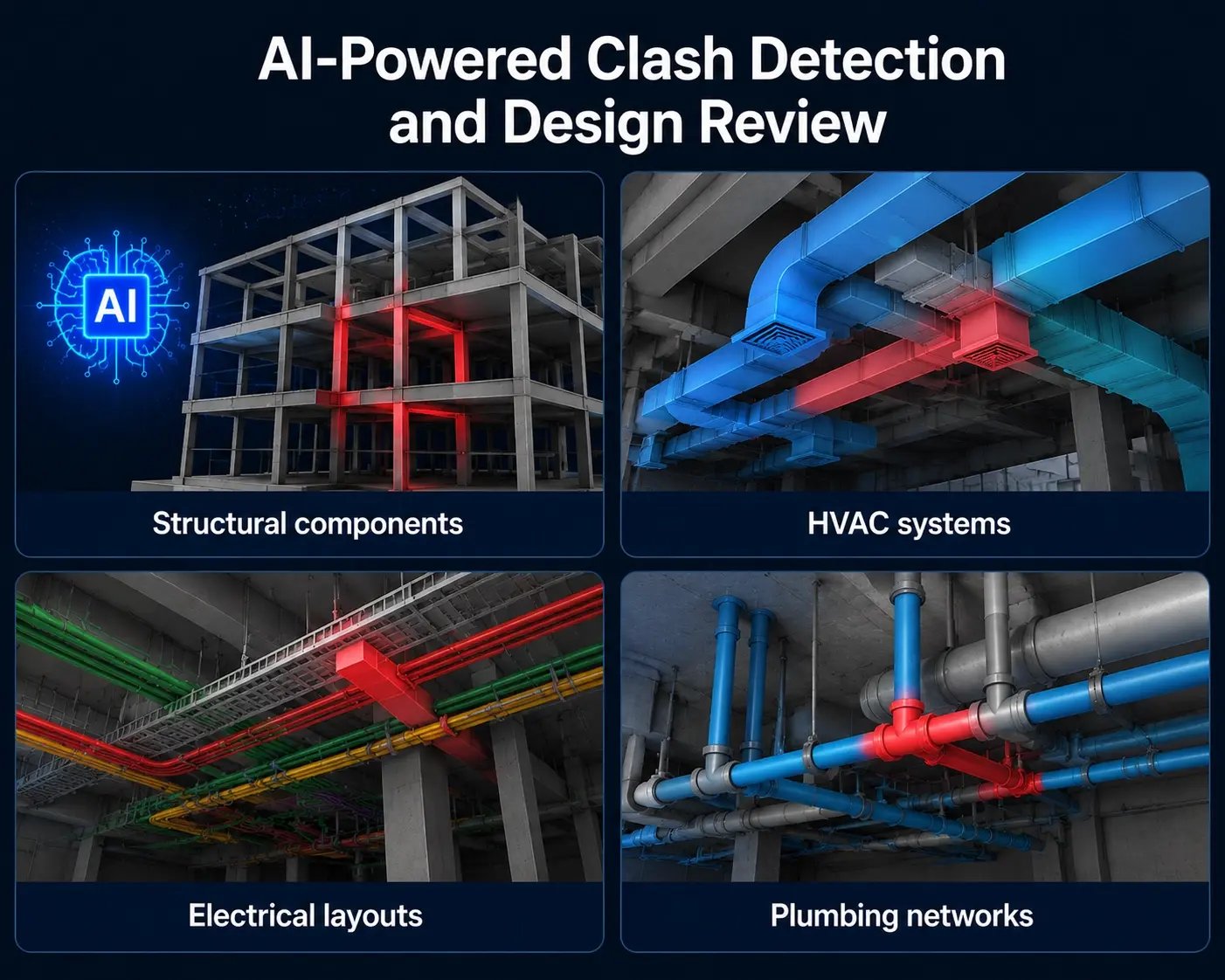
Traditional clash detection identifies conflicts between building systems such as:
Structural components
Electrical layouts
Plumbing networks
AI enhances this process by prioritizing clashes based on project impact.
Instead of reviewing thousands of potential conflicts manually, AI can:
Identify critical clashes first
Predict downstream construction issues
Recommend design modifications
Reduce coordination time
This helps project teams resolve problems before construction begins, significantly reducing costly rework.
AI doesn’t just detect clashes—it prevents costly consequences.
Project delays remain one of the biggest challenges in construction.
AI integrated with BIM can analyze:
Historical project data
Construction sequences
Labor availability
Material delivery schedules
Weather conditions
The system can then predict potential delays before they occur.
Benefits include:
Improved schedule reliability
Better resource allocation
Reduced downtime
Faster project delivery
Instead of reacting to problems, teams can proactively manage project risks.
Accurate cost estimation is critical for project success.
AI-powered BIM workflows automate:
Quantity extraction
Material calculations
Cost forecasting
Budget analysis
By learning from previous projects, AI can identify cost trends and forecast budget overruns before they become major issues.
Construction projects generate thousands of documents, including:
RFIs
Submittals
Change orders
Inspection reports
AI can automate many documentation tasks by:
Extracting information from BIM models
Generating reports automatically
Organizing project records
Tracking revisions
Automation is turning construction administration into a competitive advantage.
Construction projects involve numerous risks related to:
Safety
Design coordination
Scheduling
Budget control
Quality management
AI continuously analyzes BIM data and project information to identify risk indicators.
Examples include:
Potential safety hazards
Design inconsistencies
Resource shortages
Schedule conflicts
Budget deviations
Early identification allows teams to take corrective actions before issues escalate.
AI-powered technologies are transforming site management through:
The construction site is becoming as intelligent as the building itself.
Drones capture site images and progress updates.
AI compares captured data with BIM models to:
Verify construction progress
Identify deviations
Track project milestones
Improve reporting accuracy
AI-enabled cameras can monitor:
Worker safety compliance
Equipment usage
Site productivity
Construction quality
These insights help project managers make informed decisions in real time.
One of the most exciting developments in 2026 is the integration of BIM, AI, and Digital Twin technology.
Digital Twins are giving buildings a memory, and AI is giving them a brain.
AI enhances Digital Twins by:
Predicting equipment failures
Optimizing building performance
Monitoring energy consumption
Improving maintenance planning
Facility managers can use these intelligent systems to maximize operational efficiency long after construction is completed.
Generative Design is becoming increasingly popular in modern construction workflows.
Using project requirements and BIM data, AI can generate multiple design alternatives based on:
Cost targets
Sustainability goals
Structural requirements
Space utilization
Energy efficiency
This leads to smarter, more optimized building designs.
Sustainability is now a major priority across the construction industry.
AI-driven BIM workflows support greener construction by:
Reducing material waste
Improving energy modeling
Optimizing resource usage
Lowering carbon emissions
Supporting lifecycle analysis
Organizations can meet sustainability goals while simultaneously reducing costs.
AI explores thousands of possibilities so teams can build the best one.
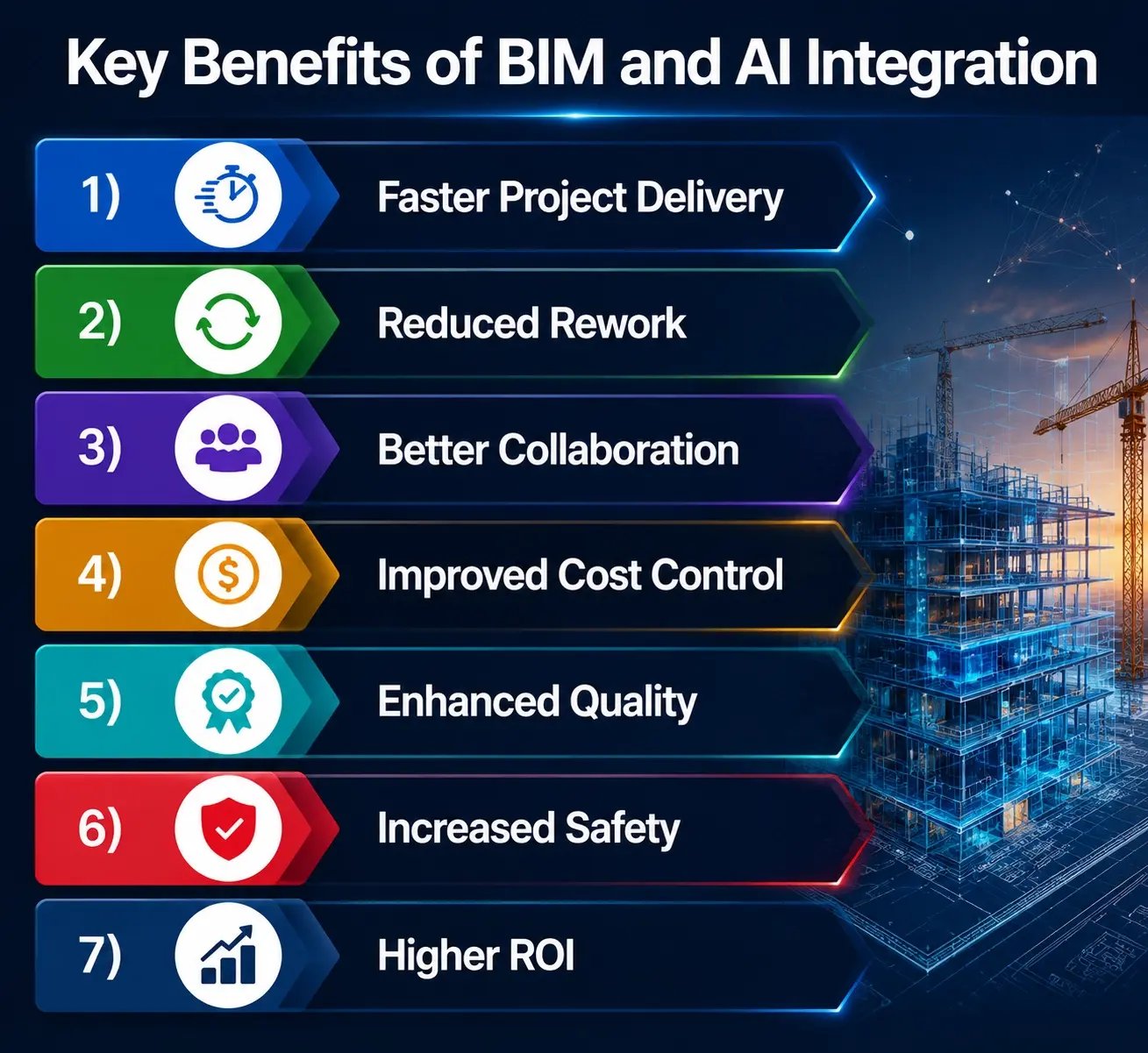
Companies adopting BIM and AI are experiencing significant advantages:
1) Faster Project Delivery
Automation reduces manual processes and accelerates decision-making.
2) Reduced Rework
Early issue detection prevents costly construction errors.
3) Better Collaboration
Teams work from a single source of intelligent project data.
4) Improved Cost Control
Predictive Analytics help maintain project budgets.
5) Enhanced Quality
AI improves design accuracy and construction verification.
6) Increased Safety
Real-time monitoring helps identify potential hazards.
7) Higher ROI
Smarter workflows lead to more profitable projects.
As AI technology continues to evolve, BIM platforms will become increasingly intelligent.
Future developments will include:
Autonomous project monitoring
AI-generated construction schedules
Real-time predictive risk management
Intelligent digital twins
Automated quality inspections
Self-optimizing building operations
Construction companies that embrace BIM and AI today will be better positioned to compete in an increasingly digital industry.
The integration of BIM and AI is fundamentally changing how construction projects are planned, designed, built, and managed.
BIM provides the digital foundation, while AI delivers the intelligence needed to transform data into actionable insights.
Ready to transform project data into project intelligence? Partner with BIMBOSS CONSULTANTS to unlock the full potential of BIM and AI-driven construction.
