
bim
BIMServices
AEC
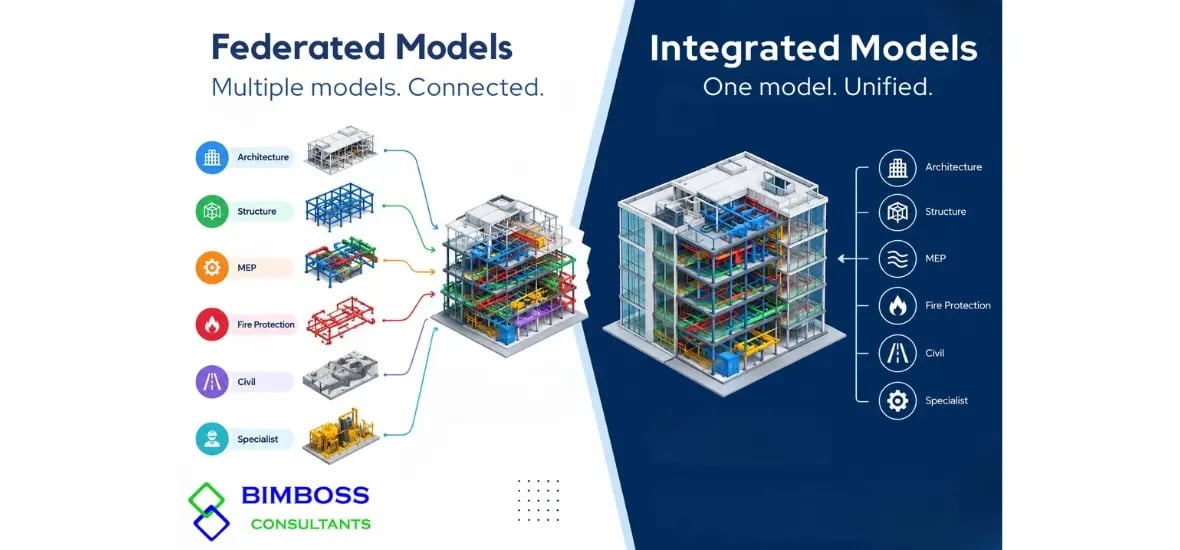

Modern BIM projects rarely depend on a single model. Architecture, structure, MEP, fire protection, civil, and specialist teams often develop information using different authoring platforms and workflows.
This is where the difference between a federated model and an integrated model becomes important. Both approaches connect multidisciplinary BIM information, but they do it in fundamentally different ways.
A federated model combines separate discipline models in one shared coordination environment. Each team develops and manages its own model independently.
The models remain separate while providing a unified view of the project. This enables better coordination, communication, and understanding across disciplines.
A simplified federated workflow can follow:
Author → Link → Coordinate → Review → Update → Re-coordinate
The individual models remain independent, but coordination happens through the combined environment.
An integrated model takes collaboration further by bringing project information into a more connected modeling environment.
Instead of treating discipline models primarily as separate files that are coordinated together, the workflow aims for stronger integration between disciplines, information, and processes.
The easiest way to understand the distinction is to look at how information is connected.
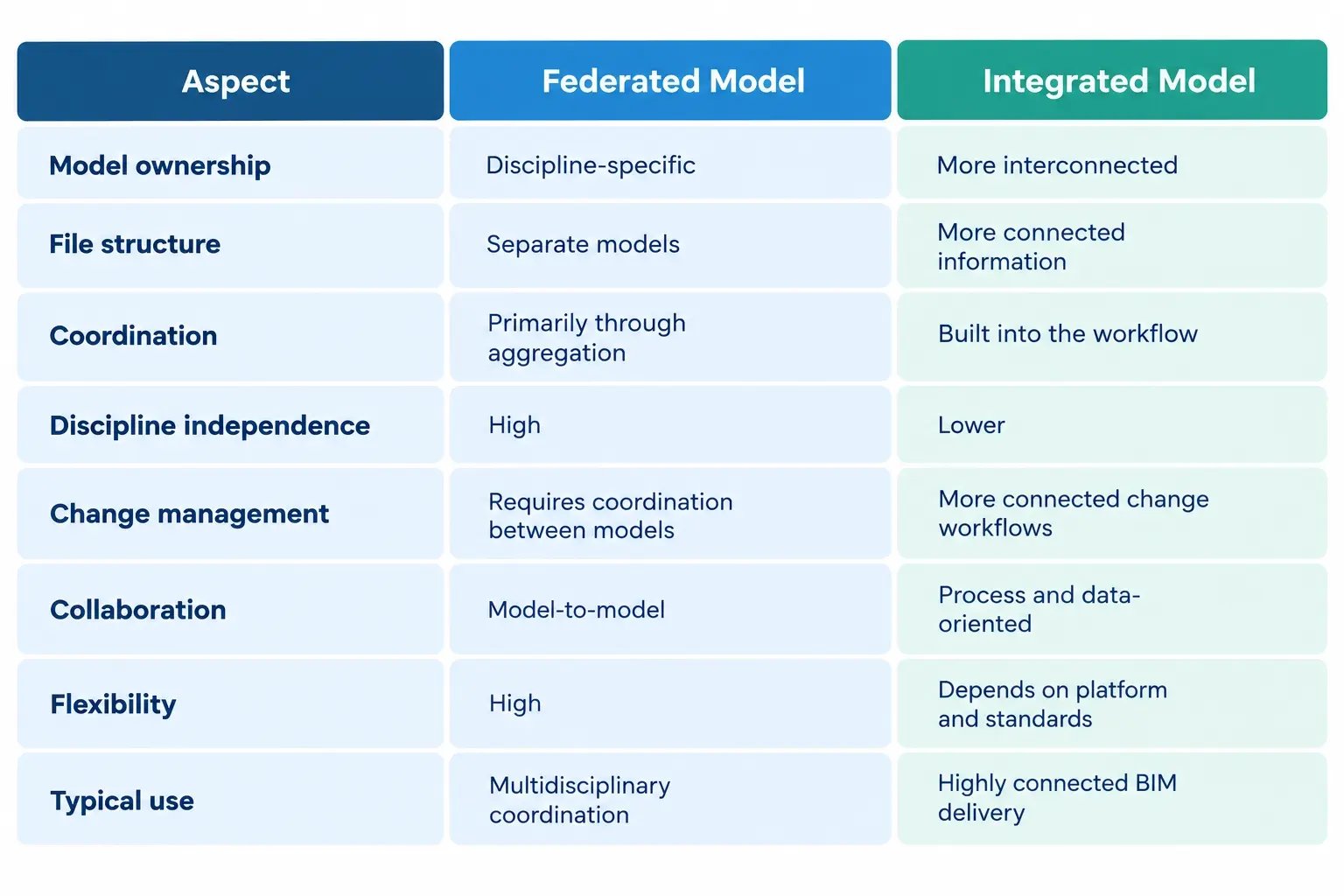 Where Federated Models Can Become Challenging
The flexibility of federation also introduces coordination responsibilities.
Other challenges can include:
Different coordinate systems
Inconsistent naming conventions
Model version conflicts
Duplicate information
Different levels of development
Parameter inconsistencies
Delayed model exchanges
Coordination issues between software platforms
The federated model can therefore be highly effective, but its success depends heavily on information management discipline.
An HVAC duct passing through a structural beam creates a clash detected by combining architectural, structural, and MEP models.
Connected information and workflows help determine why the clash occurred, who must act, and which design data is affected.
The approved resolution can then flow through the related project processes.
Modern BIM projects rarely operate within a single software ecosystem. Different disciplines may use different authoring, analysis, and coordination platforms, making software interoperability essential for exchanging BIM information effectively.
Formats such as IFC support open information exchange, while coordination platforms can combine models from multiple sources. A Common Data Environment (CDE) adds another layer by managing models, documents, revisions, approvals, and information exchanges within a structured workflow.
In federated workflows, a well-managed CDE helps teams access the correct and current model versions while maintaining better information traceability.
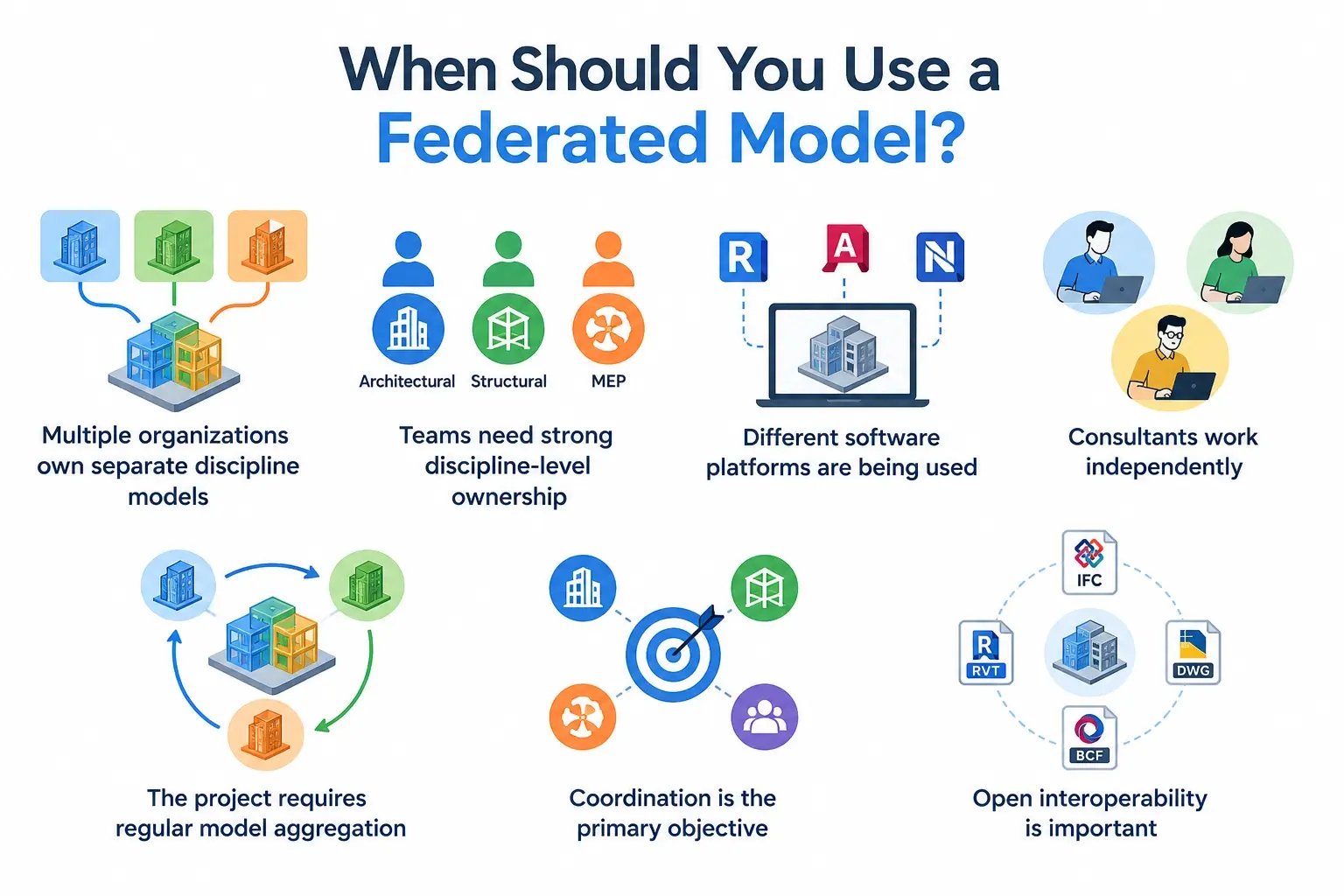 A federated approach can be highly suitable when:
Multiple organizations own separate discipline models
Teams need strong discipline-level ownership
Different software platforms are being used
Consultants work independently
The project requires regular model aggregation
Coordination is the primary objective
Open interoperability is important
For many large multidisciplinary projects, federation provides the practical balance between team independence and project-wide visibility.
A more integrated approach becomes attractive when the project requires deeper information connectivity.
It can be useful when:
Multiple BIM processes need to share structured information
Model data feeds downstream workflows
Construction and operations require connected information
Automated data exchange is important
Project teams operate within a common information framework
Digital delivery extends beyond design coordination
The greater the project's dependency on connected information, the more valuable integration can become.
The choice does not have to be federated OR integrated; teams can maintain independent discipline models while working within a shared project ecosystem.
Common standards, CDEs, coordinated parameters, automated workflows, and structured information exchanges can create stronger integration across the project.
BIM coordination is evolving beyond combining models toward stronger connections between information, people, and decisions.
A federated approach coordinates separate models, while an integrated approach connects project information for better decision-making.
This becomes increasingly important across construction planning, quantity management, digital delivery, and facility operations.
Federated and integrated models solve different problems. Federation provides a practical structure for multidisciplinary coordination while allowing teams to retain ownership of their individual models.
The future of BIM coordination is unlikely to depend on choosing one approach universally.
Federated or integrated, the goal is the same: smarter coordination and better project outcomes. Ready to strengthen your BIM workflow? Connect with BIMBOSS CONSULTANTS today!