---
title: How BIM Is Shaping the Future of Airports and Transportation Infrastructure
description: The future of transportation is digital. Explore how BIM, AI, Digital Twins, and IoT are creating smarter airports, railways, and highways.
image: https://www.blogs.bimboss.com/hubfs/Untitled%20(1200%20x%20628%20px)%20(7).webp
---
[Skip to content](https://www.blogs.bimboss.com/blog/how-bim-is-shaping-the-future-of-airports-and-transportation-infrastructure-in-2026#main-content)
[Homepage](https://bimboss.com)
- [Home](https://bimboss.com/)
- [About Us](https://bimboss.com/about-us/)
- [Service](https://bimboss.com/services/)
- [Projects](https://bimboss.com/projects/)
- [Blog](https://www.blogs.bimboss.com/blog)
- [AI](https://bimboss.com/ai-in-architecture/)
- [Digital Twin](https://bimboss.com/digital-twin-aec/)
[Get started](https://bimboss.com/contact/)
- [Home](https://bimboss.com/)
- [About Us](https://bimboss.com/about-us/)
- [Service](https://bimboss.com/services/)
- [Projects](https://bimboss.com/projects/)
- [Blog](https://www.blogs.bimboss.com/blog)
- [AI](https://bimboss.com/ai-in-architecture/)
- [Digital Twin](https://bimboss.com/digital-twin-aec/)
[Get started](https://bimboss.com/contact/)
%20(7).webp?width=1200&height=628&name=Untitled%20(1200%20x%20628%20px)%20(7).webp)
ai 3D bim 5D bim
# How BIM Is Shaping the Future of Airports and Transportation Infrastructure

bimboss
July 10, 2026
## **Introduction**
The transportation industry is entering a new digital era, with smarter airports, efficient railways, and intelligent highways powered by real-time data.
**[Building Information Modeling (BIM)](https://bimboss.com/services/bim-modeling/)** drives this transformation. Originally developed as a design tool, BIM now serves as the digital backbone of modern transportation infrastructure. It enables seamless collaboration, supports sustainability goals, and improves asset management from planning and construction to long-term operations.

Growing investments in [transportation infrastructure](https://www.blogs.bimboss.com/blog/how-bim-helps-in-smart-highway-and-tunnel-projects?hsLang=en) are driving the adoption of BIM, **Digital Twins**, and IoT technologies. Together, these solutions help organizations improve project efficiency, optimize operations, and maximize asset performance
**BIM is no longer just shaping infrastructure—it’s powering the intelligence behind it.**
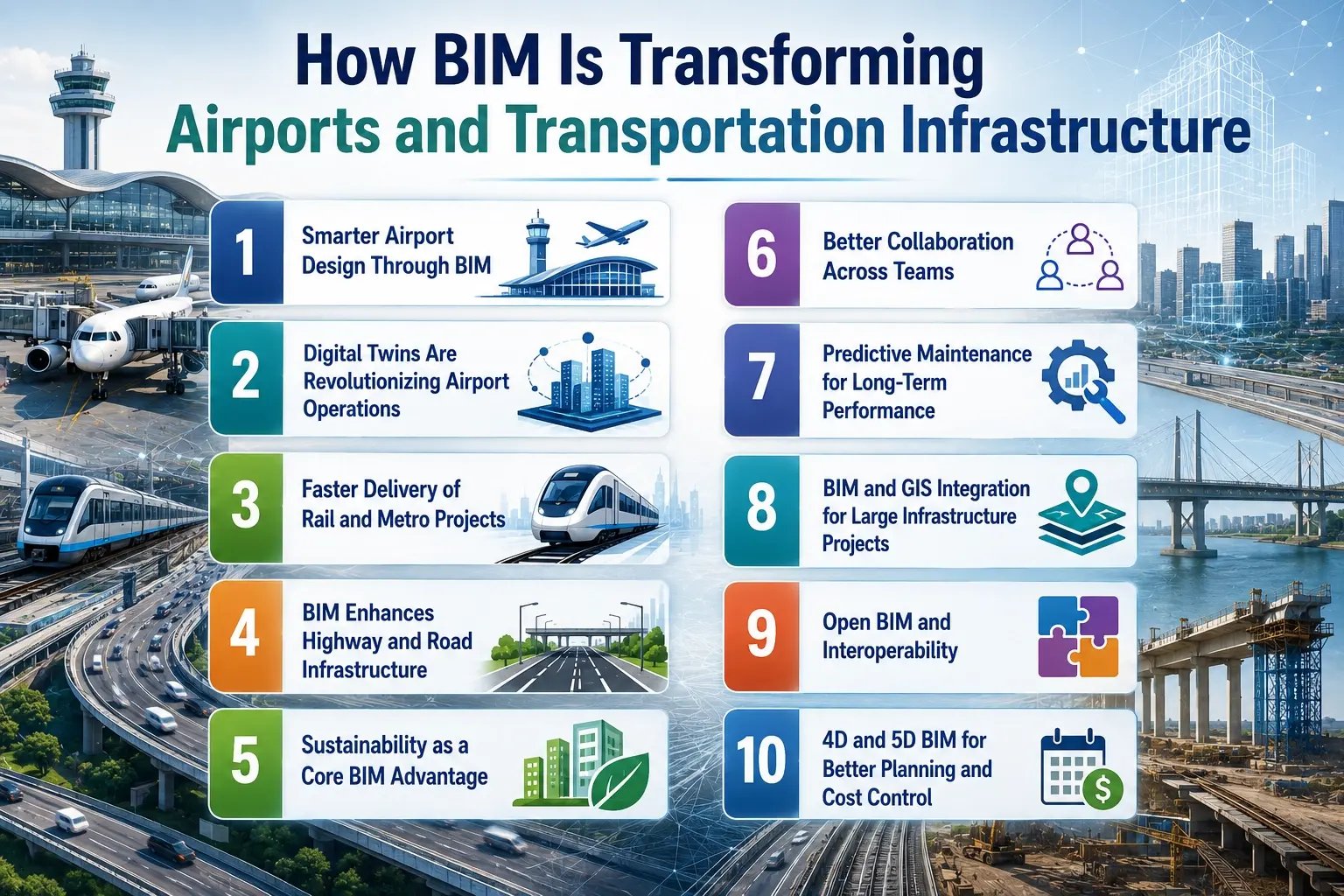
## **How BIM Is Transforming Airports and Transportation Infrastructure**
**[](https://www.blogs.bimboss.com/blog/technology-driven-nation-building-for-indias-future?hsLang=en)**
### **1. Smarter Airport Design Through BIM**
Modern airports are far more than terminals—they are complex ecosystems that include passenger areas, runways, retail zones, parking, baggage systems, and utility networks.
With BIM, designers can visualize the entire airport digitally before construction begins. This helps improve passenger flow, make better use of space, enhance safety planning, and identify design conflicts early.
### **2. Digital Twins Are Revolutionizing Airport Operations**
A major trend in 2026 is the integration of BIM with [Digital Twin technology](https://bimboss.com/digital-twin/)—a virtual replica of a physical asset that receives real-time operational data.
This allows airport operators to monitor energy usage, track equipment performance, predict maintenance requirements, optimize [**HVAC systems**](https://bimboss.com/services/mechanical-hvac-bim/), and improve passenger experiences.
### **3. Faster Delivery of Rail and Metro Projects**
Rail and metro projects involve complex coordination between stations, tracks, tunnels, bridges, drainage, and utilities.
BIM allows project teams to develop integrated corridor designs within a single intelligent model.
### **4. BIM Enhances Highway and Road Infrastructure**
For highways and roads, BIM creates intelligent models that combine road geometry, bridges, culverts, drainage systems, traffic networks, and utilities.
This approach improves route planning, quantity estimation, construction sequencing, and long-term asset management.
****From runways to railways, every journey is being redesigned in real time through digital intelligence.****
### **5. Sustainability as a Core BIM Advantage**
Sustainability has become a key priority for infrastructure projects worldwide.
BIM helps engineers analyze energy performance, daylight usage, HVAC efficiency, carbon emissions, and material consumption during the design stage.
### **6. Better Collaboration Across Teams**
Transportation projects involve architects, engineers, contractors, government agencies, and facility managers.
BIM provides a **Common Data Environment (CDE)** where everyone works with the same up-to-date information.
### **7. Predictive Maintenance for Long-Term Performance**
This reduces downtime, lowers maintenance costs, and extends the lifespan of critical airport and transportation assets.
BIM extends beyond maintenance by supporting **Asset Information Management (AIM)**. It enables facility managers to organize and manage asset data, warranty information, spare parts inventories, and operational records throughout the lifecycle of infrastructure assets.
### **8. BIM and GIS Integration for Large Infrastructure Projects**
One of the most significant developments in transportation infrastructure is the integration of BIM with **Geographic Information Systems (GIS)**.
**Together, BIM and GIS enable:**
- Corridor alignment optimization
- Terrain and topographic analysis
- Land acquisition planning
- Environmental impact assessment
- Utility mapping and route optimization
This integration is especially valuable for airports, railways, metro corridors, and highway projects that span large geographic areas.
### **9. Open** **BIM and Interoperability**
Transportation projects involve multiple stakeholders using different software platforms. Open BIM ensures seamless collaboration by enabling data exchange between various BIM applications.
**IFC (Industry Foundation Classes)** standards support seamless data exchange across BIM platforms. This allows architects, engineers, contractors, and asset owners to work with different tools while ensuring data consistency and project coordination.
### **10. [4D and 5D BIM](https://bimboss.com/services/3d-4d-5d-bim-modeling/) for Better Planning and Cost Control**
Modern transportation infrastructure increasingly relies on 4D and 5D BIM technologies.
**4D BIM combines 3D models with time schedules, enabling teams to:**
- Visualize construction sequences
- Optimize project phasing
- Reduce delays
- Improve construction planning
**5D BIM adds cost information to the model, allowing teams to:**
- Generate accurate quantity takeoffs
- Forecast project costs
- Track budgets in real time
- Improve lifecycle cost management
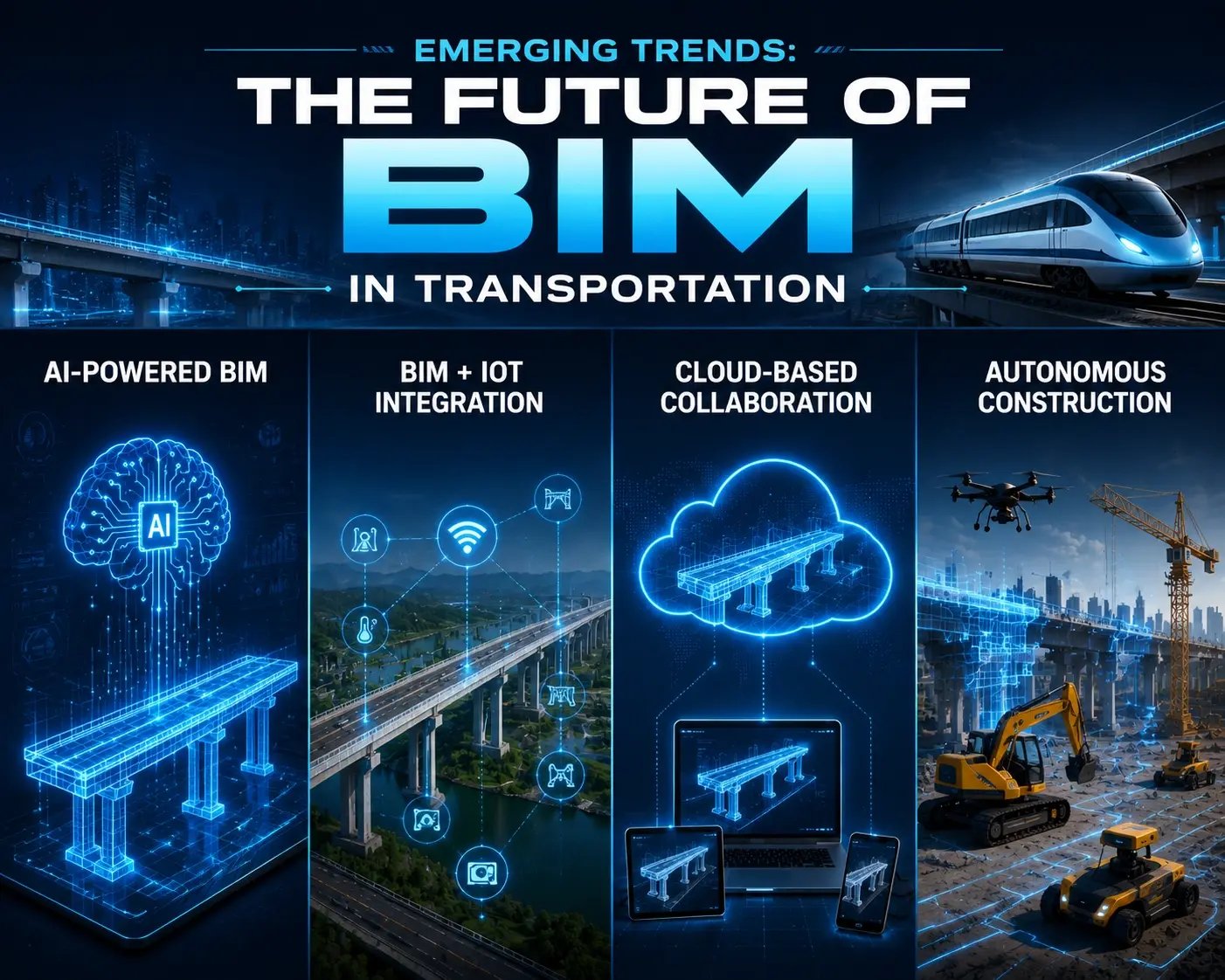
## **Emerging Trends: The Future of BIM in Transportation**
**[](https://www.blogs.bimboss.com/blog/top-ai-trends-shaping-bim-and-architecture-in-north-america?hsLang=en)**
### **AI-Powered BIM**
**[Artificial Intelligence](https://bimboss.com/ai-in-architecture/) helps automate:**
- Design optimization
- [**Clash detection**](https://bimboss.com/services/bim-clash-detection/)
- Risk assessment
- Construction planning
AI is also beginning to generate design alternatives, optimize passenger flow in airports, automate quantity takeoffs, and improve project scheduling.
### **BIM + IoT Integration**
**Sensors installed across infrastructure provide real-time data for:**
- Traffic monitoring
- Energy management
- [Structural](https://bimboss.com/services/structural-bim-modeling/) health monitoring
- Equipment performance
### **Cloud-Based Collaboration**
Cloud BIM enables teams across different locations to collaborate seamlessly and access project data anytime.
### **Autonomous Construction**
Robotics, machine control systems, and BIM are increasingly supporting semi-autonomous construction activities such as:
- Automated surveying
- Machine guidance
- Site monitoring
- Construction progress tracking
This improves construction accuracy, efficiency, and safety.
## **Why BIM Will Define the Next Generation of Infrastructure**
**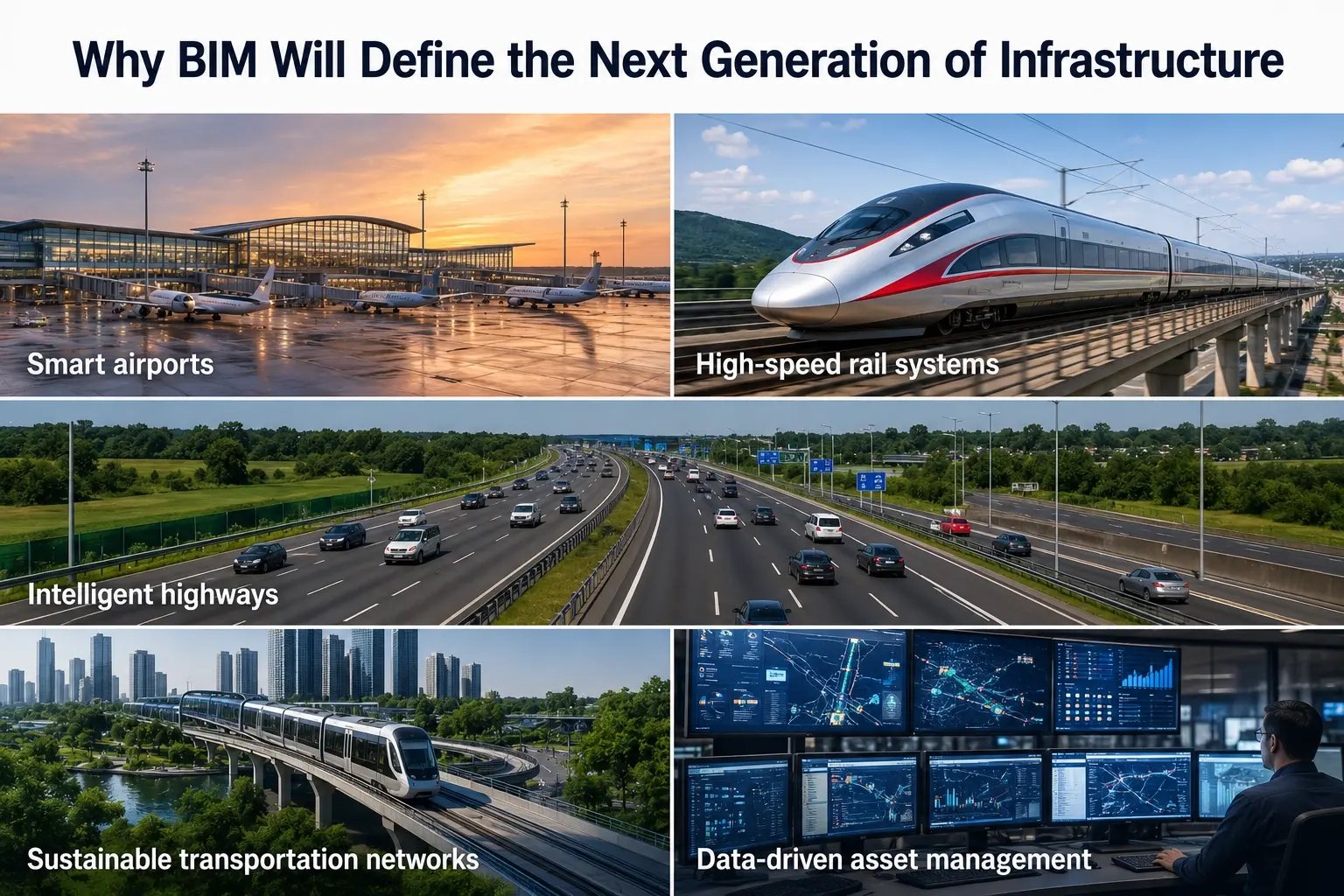**
**The infrastructure sector is moving toward:**
- Smart airports
- High-speed rail systems
- Intelligent highways
- Sustainable transportation networks
- Data-driven asset management
BIM serves as the foundation for all these innovations.
**Organizations that adopt BIM today gain:**
- Faster project delivery
- Lower lifecycle costs
- Better sustainability performance
- Enhanced operational efficiency
- Improved stakeholder collaboration
Governments, owners, and project teams are embracing BIM to create smarter, more sustainable, and resilient infrastructure.
## **Future Airports Will Have AI -Powered a Digital Twin That Never Sleeps**
The next generation of airports will move beyond traditional Digital Twins that simply collect and display operational data.
**Future** **AI-powered Digital Twins** will act as intelligent decision-support systems that continuously learn, predict, and optimize airport operations in real time.
As leading [BIM Consultants India](https://bimboss.com/), we leverage AI-driven Digital Twin technology to help airports enhance efficiency, improve safety, and make smarter operational decisions through intelligent BIM solutions.
**Instead of only monitoring equipment and infrastructure, these advanced Digital Twins will:**
- Predict equipment failures before they occur using AI and machine learning.
- Optimize passenger flow by forecasting congestion and suggesting operational adjustments.
- Automatically improve energy efficiency by dynamically controlling HVAC, lighting, and other building systems.
- Simulate emergency scenarios and test operational strategies before implementing them in the real world.
- Support autonomous maintenance planning, reducing downtime and improving asset reliability.
By integrating BIM, AI, IoT, and real-time Analytics, airports will become intelligent digital ecosystems that adapt to changing operational demands in real time.
In the future, Digital Twins will not just reflect what is happening inside an airport—they will help determine what should happen next, enabling safer, smarter, and more efficient airport operations.
****The future of infrastructure isn’t just built—it’s simulated, optimized, and continuously evolving.****
## **Final Thoughts**
The future of airports and transportation infrastructure is digital, connected, and intelligent—and BIM is at the heart of this transformation.
Organizations use BIM to improve collaboration, control costs, and deliver smarter infrastructure across airport terminals, railway networks, and smart highways.
****Build smarter, faster, and more connected infrastructure with** **[BIMBOSS CONSULTANTS](https://bimboss.com/)** **driving BIM innovation forward.****
### **FAQ :-**
Why are airports investing in BIM and Digital Twin technology?
Airports use BIM and Digital Twins to improve passenger experience, reduce operational costs, enhance safety, optimize energy consumption, monitor assets in real time, and support predictive maintenance.
How does BIM support smart highway development?
BIM enables intelligent modeling of roads, bridges, drainage systems, utilities, and traffic networks, improving route planning, construction sequencing, maintenance strategies, and long-term asset management.
Why is predictive maintenance becoming essential for airports?
Predictive maintenance uses AI, BIM, and IoT data to identify potential equipment failures before they occur, reducing downtime, improving passenger safety, lowering maintenance costs, and extending asset life.
### Explore more :-
[How BIM Helps in Smart Highway and Tunnel Projects](https://www.blogs.bimboss.com/blog/how-bim-helps-in-smart-highway-and-tunnel-projects?hsLang=en)
[Technology-Driven Nation Building for India’s Future](https://www.blogs.bimboss.com/blog/technology-driven-nation-building-for-indias-future?hsLang=en)
[Why More Contractors Are Switching to BIM Outsourcing in 2026](https://www.blogs.bimboss.com/blog/why-more-contractors-are-switching-to-bim-outsourcing-in-2026?hsLang=en)
[The Hidden Technology Stack Behind Successful Smart Cities](https://www.blogs.bimboss.com/blog/the-hidden-technology-stack-behind-successful-smart-cities?hsLang=en)
[AI-Powered Construction Monitoring: USA, UK & Canada](https://www.blogs.bimboss.com/blog/ai-powered-construction-monitoring-usa-uk-canada?hsLang=en)
## Share this post
[mailto:https%3A%2F%2Fwww.blogs.bimboss.com%2Fblog%2Fhow-bim-is-shaping-the-future-of-airports-and-transportation-infrastructure-in-2026](mailto:https%3A%2F%2Fwww.blogs.bimboss.com%2Fblog%2Fhow-bim-is-shaping-the-future-of-airports-and-transportation-infrastructure-in-2026)
## Keep reading
### [.webp?width=1180&height=550&name=LIDAR+AI+BIM%20(1180%20x%20550%20px).webp) ai Scan-to-BIM AEC LiDAR + AI + BIM: The New Reality-Capture Stack](https://www.blogs.bimboss.com/blog/lidar-ai-bim-the-new-reality-capture-stack?hsLang=en)
### [ DroneSurveyIndia DigitalTwinTechnology Digital Twin From Digital Twin to Physical Twin: The Next Evolution of Construction Technology](https://www.blogs.bimboss.com/blog/from-digital-twin-to-physical-twin-the-next-evolution-of-construction-technology?hsLang=en)
[](https://bimboss.com/)
#### Our Office
- [New York](https://bimboss.com/bim-services-new-york/)
- [Chicago](https://bimboss.com/bim-services-chicago/)
- [Los Angeles](https://bimboss.com/bim-services-los-angeles/)
- [Dallas](https://bimboss.com/bim-services-dallas/)
- [San Jose](https://bimboss.com/bim-services-san-jose/)
- [San Diego](https://bimboss.com/bim-services-san-diego/)
- [Washington](https://bimboss.com/bim-services-washington/)
#### Quick Links
- [Home](https://bimboss.com/)
- [About Us](https://bimboss.com/about-us/)
- [Services](https://bimboss.com/services/)
- [Projects](https://bimboss.com/projects/)
- [Blogs](https://bimboss.com/blogs/)
- [Digital Twin AEC](https://bimboss.com/digital-twin-aec/)
- [AI](https://bimboss.com/ai-in-architecture/)
- [Contact Us](https://bimboss.com/contact/)
- [Privacy Policy](https://bimboss.com/privacy-policy/)
#### Services
- [Virtual Reality](https://bimboss.com/services/virtual-reality-service/)
- [Clash Detection](https://bimboss.com/services/bim-clash-detection/)
- [Energy Modeling](https://bimboss.com/services/energy-modeling-design/)
- [Rendering Services](https://bimboss.com/services/3d-rendering/)
- [Plumbing](https://bimboss.com/services/plumbing-design-drafting/)
- [4D 5D Modeling](https://bimboss.com/services/3d-4d-5d-bim-modeling/)
#### Contact Us
307, Empire hub, Besides Kansas building, Near Ghodasar x road, Ahmedabad
1309 Coffeen Avenue STE 1200, Sheridan, WY 82801
+91 9726864634
+1 845-445-4108
projects@bimboss.com
psoni@bimboss.com
---
[Privacy Policy](https://bimboss.com/privacy-policy/) · Legal · © 2025. All rights reserved.
```json
{
"@context" : "https://schema.org",
"@type" : "BlogPosting",
"author" : {
"@type" : "Person",
"name" : "bimboss",
"url" : "https://www.blogs.bimboss.com/blog/author/bimboss"
},
"dateModified" : "2026-07-10T11:09:06.654Z",
"datePublished" : "2026-07-10T11:08:26.000Z",
"headline" : "How BIM Is Shaping the Future of Airports and Transportation Infrastructure",
"image" : [ "https://www.blogs.bimboss.com/hubfs/Untitled%20(1200%20x%20628%20px)%20(7).webp" ],
"mainEntityOfPage" : {
"@id" : "https://www.blogs.bimboss.com/blog/how-bim-is-shaping-the-future-of-airports-and-transportation-infrastructure-in-2026",
"@type" : "WebPage"
},
"publisher" : {
"@type" : "Organization",
"logo" : {
"@type" : "ImageObject",
"url" : "https://www.blogs.bimboss.com/hubfs/01.png"
},
"name" : "bimboss consultants"
}
}
```
```json
{
"@context" : "https://schema.org",
"@type" : "Article",
"author" : {
"@type" : "Person",
"name" : "Parthesh Soni"
},
"datePublished" : "2026-07-10",
"headline" : "How BIM Is Shaping the Future of Airports and Transportation Infrastructure",
"image" : "https://9311231.fs1.hubspotusercontent-na2.net/hub/9311231/hubfs/Untitled%20(1200%20x%20628%20px)%20(7).webp?width=1200&height=628&name=Untitled%20(1200%20x%20628%20px)%20(7).webp",
"publisher" : {
"@type" : "Organization",
"logo" : {
"@type" : "ImageObject",
"url" : "https://bimboss.com/wp-content/uploads/2022/12/site-logo.png"
},
"name" : "BIMBoss"
}
}
```