
.webp?width=1200&height=628&name=Untitled%20design%20(22).webp)
ai
ConstructionTechnology
AEC
%20(9).webp?width=1200&height=628&name=Untitled%20(1200%20x%20628%20px)%20(9).webp)

The construction industry is undergoing one of the biggest digital transformations in its history, and at the center of this change is Building Information Modeling (BIM).
What was once considered a specialized design tool has evolved into a complete project management strategy that connects architects, engineers, contractors, and facility managers on a single digital platform.
In 2026, BIM is no longer just about creating 3D models. It is helping companies reduce project delays, control budgets, improve collaboration, and make better decisions throughout the entire building lifecycle.
A BIM (Building Information Modeling) strategy is a planned approach to managing construction projects using digital models and real-time data.
It helps architects, engineers, and contractors collaborate on a single platform, improving accuracy and efficiency.
A BIM strategy typically includes:
3D building modeling
Project planning
Team collaboration
Cost estimation
Construction scheduling
Facility management
By using a centralized digital model, teams can reduce errors and make better decisions throughout the project lifecycle.
Construction delays, budget overruns, and coordination issues are no longer unavoidable—BIM is changing the rules of the game.
The construction industry often faces challenges like budget overruns, design clashes, project delays, and poor communication.
In 2026, BIM is becoming even more powerful by integrating with technologies such as Artificial Intelligence (AI), IoT, cloud computing, digital twins, drone mapping, and laser scanning.
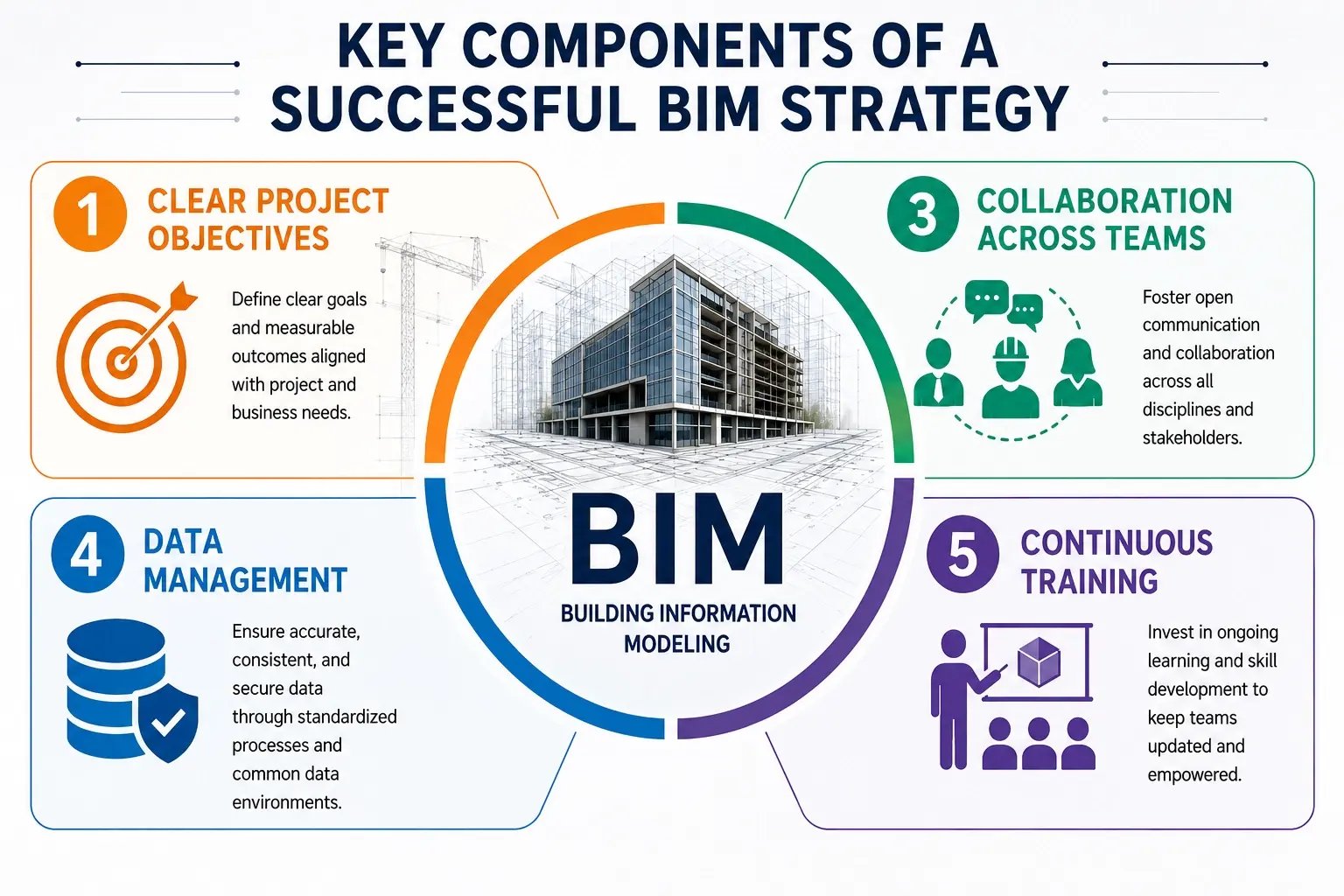
Before implementing BIM, organizations should define their goals.
Common objectives include:
Reducing construction costs
Improving collaboration
Minimizing design errors
Enhancing project visualization
Increasing sustainability
A clear roadmap ensures successful adoption.
Standard workflows help every team member follow the same procedures.
This includes:
File naming conventions
Data sharing protocols
Model update schedules
Quality control processes
Standardization reduces confusion and improves efficiency.
One of BIM's biggest strengths is collaboration.
Architecture, structural engineers, MEP designers, contractors, and project managers can work on the same model simultaneously.
This eliminates many communication gaps that often cause project delays.
Modern BIM models contain valuable project information such as:
Material specifications
Equipment details
Cost estimates
Maintenance schedules
Construction sequences
Managing this data properly helps stakeholders make informed decisions.
Technology evolves rapidly.
Construction companies need to invest in ongoing training to ensure employees understand the latest BIM software and workflows.
Imagine detecting costly construction problems before a single brick is laid. That's the power of BIM.
.webp?width=503&height=754&name=IMAGE2%20(2).webp)
Every project participant works from the same updated model.
This reduces misunderstandings and keeps everyone aligned.
BIM enables accurate quantity takeoffs and budgeting.
Teams can identify financial risks before construction begins, helping avoid unexpected expenses.
One of the most valuable BIM features is clash detection.
The software automatically identifies conflicts between structural, electrical, and mechanical systems before construction starts.
Fixing problems digitally is far less expensive than correcting them on-site.
Automated workflows reduce repetitive tasks and speed up decision-making.
This often leads to shorter construction timelines.
Clients and stakeholders can view realistic 3D models before construction begins.
This improves communication and allows for early design adjustments.
BIM supports energy analysis and material optimization.
Sustainable buildings are becoming increasingly important in global construction markets.
Project goals are established, and digital site information is collected.
Teams develop preliminary models and identify potential risks.
Architects and engineers create detailed models that integrate structural and MEP systems.
Collaborative design minimizes conflicts.
Contractors use BIM for:
Scheduling
Material planning
Resource allocation
Site coordination
Real-time updates improve project management.
After project completion, the BIM model becomes a valuable facility management tool.
Building owners can access maintenance schedules, equipment information, and renovation history.
Existing buildings are becoming a major focus in construction markets worldwide. Renovation, retrofitting, and adaptive reuse projects require accurate building information before design work begins.
This is where Scan to BIM Services and Point Cloud to BIM Services are changing the game.
Key advantages include:
Accurate existing condition documentation
Reduced site measurement errors
Faster renovation planning
Improved design accuracy
Better project coordination
As sustainability initiatives continue to grow, Scan to BIM has become one of the fastest-growing BIM services in 2026.
BIM is no longer just about designing buildings—it's about creating intelligent, data-driven assets for the future.
One of the most exciting trends shaping construction in 2026 is the rise of Digital Twins.
A digital twin combines BIM data with real-time building performance information, allowing owners and facility managers to monitor assets continuously.
Applications include:
Predictive maintenance
Energy optimization
Facility management
Asset tracking
Performance monitoring
Digital twins are transforming BIM from a construction tool into a long-term operational strategy.
Architectural BIM models provide detailed building representations that improve design visualization, coordination, and documentation.
Benefits include:
Better design communication
Accurate construction documentation
Faster approvals
Improved stakeholder collaboration
Structural BIM helps engineers create accurate structural models that improve Constructability and reduce project risks.
Benefits include:
Enhanced structural analysis
Improved fabrication accuracy
Better coordination with MEP systems
Reduced construction conflicts
Together, Architectural and Structural BIM services create a strong foundation for successful project execution.
Sustainability has become a priority across the construction industry.
BIM enables teams to:
Analyze energy performance
Optimize material usage
Reduce construction waste
Improve building efficiency
Support green building certifications
As governments and developers push for environmentally responsible construction, BIM is becoming an essential tool for achieving sustainability goals.
The future of BIM is moving toward intelligent, connected, and predictive construction workflows.
Emerging technologies include:
Automated clash resolution
Generative design
Digital twin ecosystems
Smart city integration
Cloud-based project intelligence platforms
Organizations investing in these technologies today will be better positioned to lead tomorrow's construction industry.
The BIM strategy changing construction forever in 2026 is not simply about creating 3D models. It is about connecting people, processes, and data into a unified project ecosystem.
Don't just build structures—build certainty, efficiency, and long-term value with BIM.
From Drawings to Data: How BIM Is Redefining Construction Intelligence
%20(7).webp?width=1200&height=628&name=Untitled%20(1200%20x%20628%20px)%20(7).webp)