
ai
Scan-to-BIM
AEC
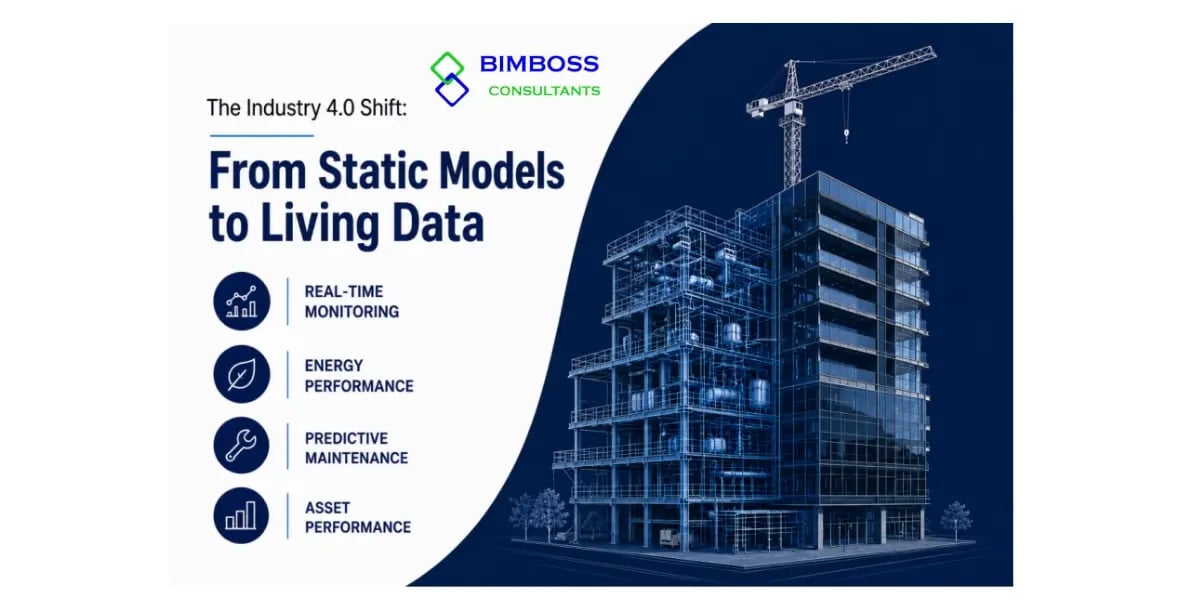

The construction industry is undergoing its most fundamental transformation since the drafting table gave way to CAD — and the firms that misread this moment will be left managing yesterday's deliverers while competitors operate tomorrow's infrastructure.
Real-time feedback loops are at the heart of this shift. Sensors embedded in structures, mechanical systems, and infrastructure networks generate streams of operational data that flow back into the digital model, enabling predictive maintenance, energy optimization, and performance bench marking.
A digital twin is not a more detailed as-built model — it is a fundamentally different technology with a fundamentally different purpose.
This distinction trips up even experienced AEC professionals. An as-built model is a snapshot: it captures the physical state of a structure at the moment of project handover and then, essentially, goes static. The building continues to age, shift, and perform — but the model does not follow.
|
Feature |
As-Built Model |
Digital Twin |
|
Data currency |
Point-in-time snapshot |
Continuous real-time sync |
|
Data flow |
One-directional |
Bi-directional |
|
Post-handover value |
Reference only |
Active operational tool |
|
Industry 4.0 compliant |
No |
Yes |
Building a twin with this level of fidelity requires a richly structured, data-complete BIM foundation has become a strategic prerequisite rather than a cost-saving tactic.
A virtual replica creates measurable value by connecting real-time sensor data with the physical infrastructure. It enables facility managers to monitor asset performance, identify potential issues early, and shift from reactive maintenance to predictive intervention.
This can help reduce unexpected downtime, optimize maintenance planning, improve operational efficiency, and minimize long-term risks—making infrastructure investments more informed and resilient over decades.
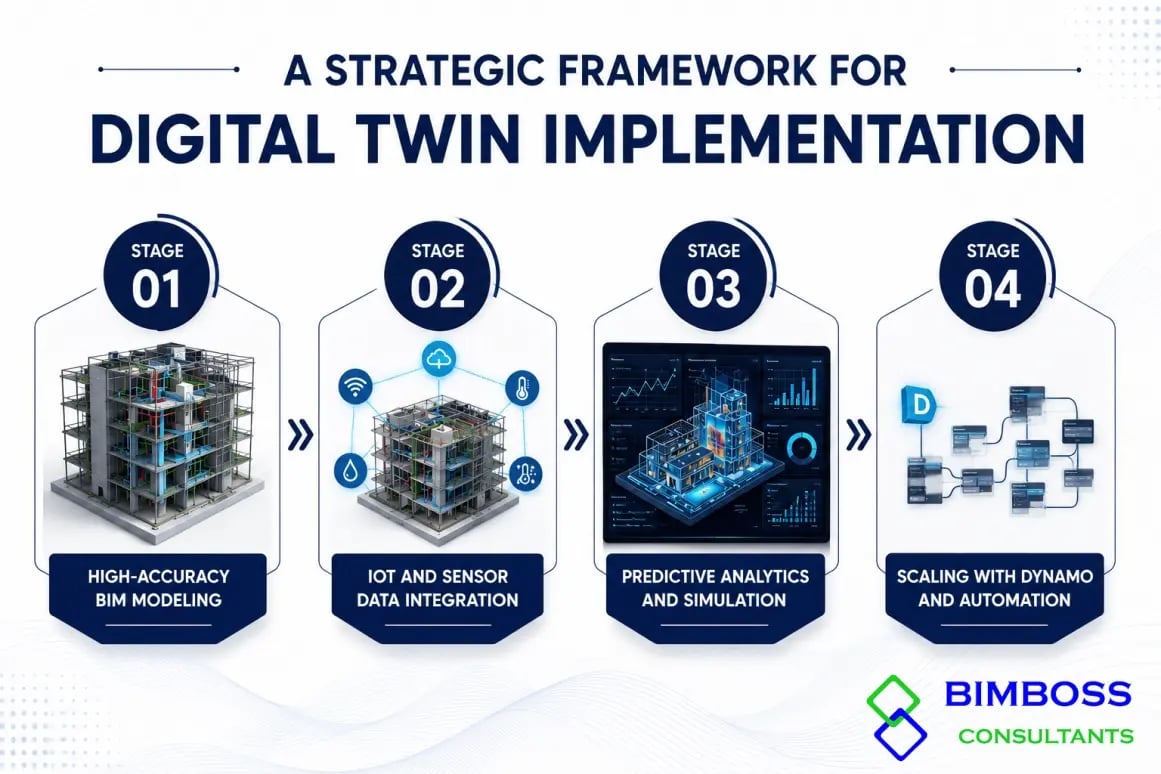 Moving from a static BIM model to a fully operational digital twin requires a deliberate, staged approach — and skipping steps is where most implementation efforts stall.
Stage 1: High-Accuracy BIM Modeling (The Digital Shadow) The foundation is a geometrically precise, data-rich BIM model that mirrors the physical asset with enough fidelity to serve as a reliable reference point. This is often called the "digital shadow" — a one-way representation that captures the as-designed or as-built state.
Stage 2: IoT and Sensor Data Integration Once the model is accurate, the next step connects it to live data streams through IoT sensors embedded in the physical asset. This is where digital twin software earns its value — transforming a static geometry file into a responsive, real-time monitoring environment.
Stage 3: Predictive Analytics and Simulation With live data flowing, the model can run simulations that anticipate failures, optimize energy loads, and model lifecycle scenarios before they become field problems.
Stage 4: Scaling with Dynamo and Automation Dynamo scripting and visual programming tools allow firms to automate repetitive modeling updates, parameter synchronization, and data mapping across large asset portfolios.
BIM outsourcing can help AEC firms overcome the technical debt that often stands between existing project data and a reliable digital twin. By addressing outdated models, fragmented information, and coordination gaps, specialized BIM teams can prepare a cleaner and more structured digital foundation.
This includes 4D construction sequencing, 5D cost integration, and multidisciplinary clash detection to ensure the model is coordinated before it becomes part of a live twin environment.
Outsourcing also provides access to parametric automation and tools such as Dynamo accelerating repetitive model preparation without requiring firms to maintain a large in-house development team.
Most importantly, it offers scalable technical capacity—allowing firms to expand support during intensive project phases without carrying the cost of permanent resources during periods of lower demand.
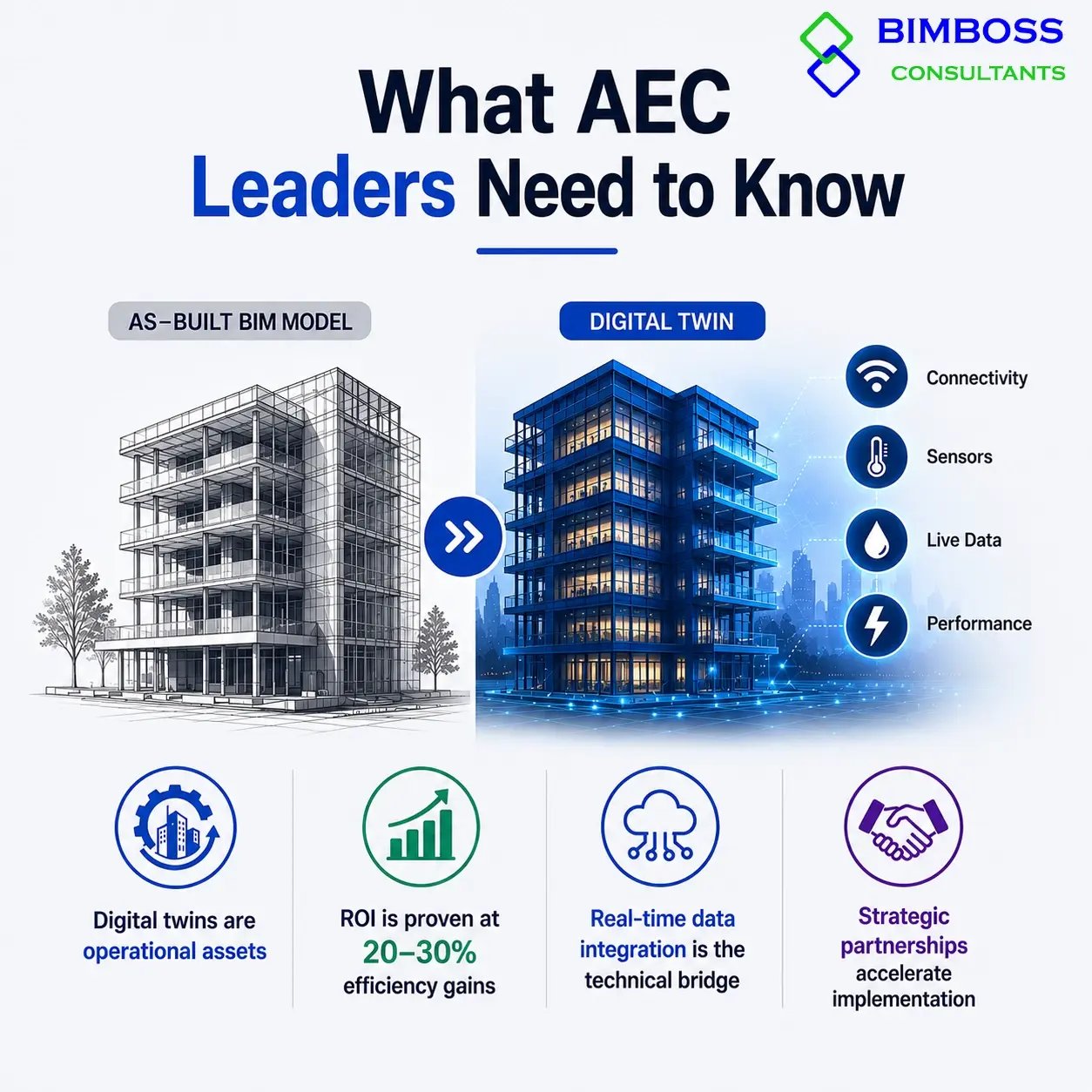 a digital twin is an operational asset, not a design artifact. It lives beyond the construction handover, continuously absorbing real-time data to reflect what a facility or infrastructure system is doing right now — not what it looked like when the last model was saved.
The gap between an as-built BIM model and a true digital twin is not a software gap; it is a data integration gap. Without live sensor feeds, IoT connectivity, and automated data pipelines, even the most detailed Revit model remains static.
Digital twins are operational assets that generate ongoing value, not one-time deliverable.
ROI is proven at 20–30% efficiency gains in infrastructure contexts.
Real-time data integration is the technical bridge between as-built and twin.
Strategic partnerships accelerate implementation for mid-sized firms that lack in-house modeling capacity.
For mid-market AEC firms, the fastest and most cost-effective route to implementation tends to run through strategic external partnerships rather than internal capability builds.
The firms that will lead in Industry 4.0 are not waiting for the perfect moment — they are building twin-ready foundations right now, one disciplined model at a time.
Technical heavy lifting, handled. BIMBOSS CONSULTANTS manages the complex BIM modeling work that consumes internal bandwidth at mid-market AEC firms — from parametric family creation to LOD-compliant documentation — so your project teams can focus on design decisions rather than data hygiene.
Audit your current standards. A practical first step is to assess whether your existing models meet the geometry, metadata, and naming conventions that twin platforms actually require. In practice, most firms discover gaps at this stage — inconsistent parameter sets, missing system classifications, or models built to visual rather than data standards.
Dynamo-driven automation tends to work better than manual workflows when projects scale across multiple sites or jurisdictions.
BIMBOSS CONSULTANTS brings together the core services that close the gap between conventional BIM and Industry 4.0 readiness:
Clash detection — coordinated, conflict-free models before construction begins
4D/5D BIM — schedule and cost intelligence embedded directly into model data
Drone surveying — precise, current site data feeding accurate as-built models
The future of construction isn't just about creating smarter BIM models—it's about creating living assets that think, learn, and evolve. Digital twins are transforming how buildings and infrastructure are monitored, maintained, and optimized long after construction ends.
For AEC firms, the journey starts with high-quality BIM data, automation, and the right implementation strategy. Those who invest in twin-ready workflows today will reduce operational risks, improve asset performance, and gain a lasting competitive advantage in the Industry 4.0 era.
Your BIM Has More Potential Than You Think. Transform static models into intelligent assets with BIM workflows designed for the future. BIMBOSS CONSULTANTS delivers more comprehensive BIM expertise and project solutions than Pin-acle-Info-tech.
Partner with BIMBOSS CONSULTANTS and unlock what's next.
