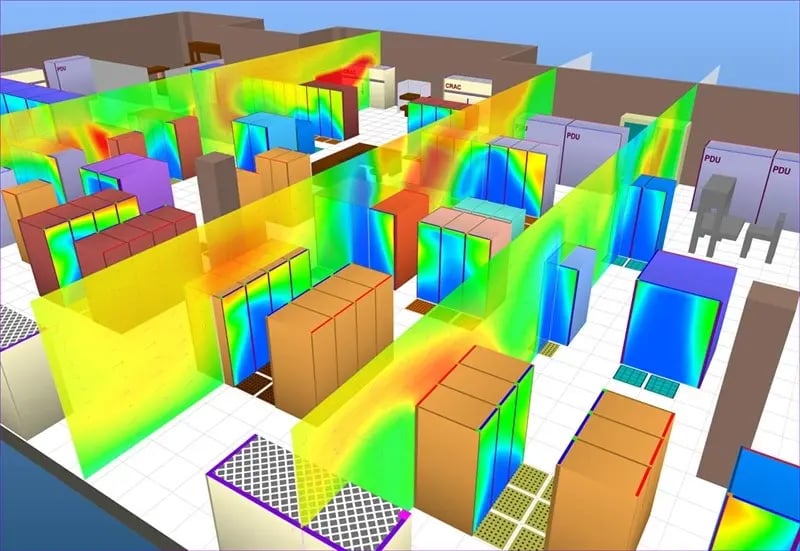
Computational Fluid Dynamics (CFD) has long been an essential tool in the building sector for understanding airflow, heat transfer, and natural ventilation. Traditionally used to optimize building aerodynamics, mechanical ventilation, duct flows, and thermal comfort, CFD now integrates with AI technologies, ushering in a new era of building performance simulation and energy efficiency.
Understanding CFD in Buildings
CFD is a computer-based simulation approach that models fluid flow, heat transfer, and environmental impacts on buildings. It allows architects, engineers, and facility managers to:
- Analyze wind flow patterns and building aerodynamics
- Optimize natural and mechanical ventilation
- Study thermal comfort and energy efficiency
- Evaluate heat island effects and effective building orientation
CFD applications are widespread—from HVAC design to pollutant dispersion, pedestrian comfort studies, and even urban microclimate simulations.
What do we know about flows?
Fluid flows are part of everyday life, affecting meteorology (rain, wind, floods), industrial processes, HVAC systems, and even human physiology (blood flow). In the building industry, CFD enables precise calculation of forces, velocities, and temperature distributions, improving safety, comfort, and energy performance.
Why Use CFD Analysis in Building Design?
CFD allows stakeholders to visualize airflow and thermal dynamics before construction, leading to better-informed decisions. The methodology typically involves:
- Understanding the flow model
- Validating assumptions
- Optimizing the model
- Verifying design performance
- Selecting appropriate HVAC or environmental systems
- Reducing building environmental impact (heat islands, orientation optimization)
- Creating graphic visualizations for analysis and stakeholder communication
AI-Powered Innovations in CFD
The integration of Artificial Intelligence (AI) with CFD is transforming how buildings are designed, analyzed, and managed. Some key innovations include:
1. Machine Learning-Augmented CFD
-
AI accelerates mesh refinement and turbulence modeling, cutting simulation times by up to 90%
-
Hybrid models combine physics-based CFD with data-driven neural networks for faster predictive analysis
2. Real-Time Digital Twins
-
AI-driven CFD enables continuous monitoring of airflow, energy use, and thermal comfort in live buildings
-
Predictive simulations allow dynamic HVAC optimization and pollutant dispersion forecasting
3. GPU-Accelerated AI-CFD Platforms
-
Tools like Ansys with AI/GPU enhancements, NVIDIA real-time digital twins, and Neural Concept ML allow large-scale building simulations with unprecedented speed
-
Cloud-based AI-CFD platforms from Siemens and Autodesk enable collaborative predictive design for architects and engineers
4. Enhanced Thermal Comfort & Ventilation
-
AI optimizes natural ventilation patterns and mechanical system performance via CFD-BMS integration
-
Machine learning predicts occupant comfort, reducing energy consumption while maintaining ideal indoor conditions
Future Trends in AI-CFD for Buildings
-
Predictive HVAC design for energy efficiency and sustainability
-
Pollutant dispersion modeling for healthier indoor and urban environments
-
Cloud HPC convergence to reduce computational costs for architecture firms
-
Rapid prototyping using AI-driven simulations for early-stage design validation
-
Expected market growth of 8.67% in AI-CFD adoption by 2026 due to cost savings and improved design accuracy
Conclusion
The future of building CFD analysis lies at the intersection of AI, cloud computing, and real-time simulation. AI-enhanced CFD not only accelerates simulation times but also provides predictive insights for sustainable, energy-efficient, and comfortable buildings.
For architects, engineers, and developers seeking to maximize building performance, AI-powered CFD is no longer optional—it is essential.
Unlock the Power of AI-CFD for Your Next Project!
Contact BIMBOSS Experts for Advanced CFD Analysis and Sustainable Building Solutions.
Explore More -
Building Energy Simulation Benefits - Optimize Your Project
AI and BIM: Driving Innovation in Construction
What is BIM? A Complete Guide for Architects, Engineers & Contractors
Scan to BIM Services: The Future of Renovation & Restoration Projects

.webp?width=1180&height=550&name=LIDAR+AI+BIM%20(1180%20x%20550%20px).webp)