
.webp?width=1180&height=550&name=LIDAR+AI+BIM%20(1180%20x%20550%20px).webp)
ai
Scan-to-BIM
AEC
%20(6)-1.webp?width=1200&height=628&name=Untitled%20(1200%20x%20628%20px)%20(6)-1.webp)

The construction, manufacturing, and facility management industries are undergoing a major digital transformation in 2026. Organizations are no longer relying solely on static models and disconnected data sources.
Instead, they are embracing intelligent, real-time virtual representations of physical assets that enable smarter decisions, better performance, and higher profitability.
Modern virtual asset environments create dynamic digital representations of physical assets, buildings, infrastructure systems, and manufacturing processes.
Unlike traditional 3D models, they continuously integrate real-time data from sensors, IoT devices, BIM models, and operational systems, enabling continuous monitoring, analysis, and optimization.
These intelligent digital environments are widely used across:
Construction Projects
Smart Buildings
Manufacturing Facilities
Airports and Transportation Hubs
Healthcare Infrastructure
Energy and Utility Networks
By integrating BIM Modeling Services with Digital Twin technology, companies gain unprecedented visibility into project performance and asset management.
.webp?width=768&height=512&name=Untitled%20design%20(23).webp) Several industry trends are driving rapid Digital Twin adoption:
Several industry trends are driving rapid Digital Twin adoption:
Building owners increasingly demand real-time operational intelligence for energy efficiency, maintenance planning, and occupant comfort.
Artificial Intelligence combined with digital twins enables predictive maintenance and operational optimization.
Organizations use digital twins to reduce energy consumption, monitor carbon emissions, and support ESG initiatives.
Instead of focusing only on construction, companies now manage assets across their entire lifecycle.
Modern BIM Coordination Services and BIM Clash Detection Services create accurate digital foundations that support reliable digital twins.
Imagine knowing when equipment will fail before it actually does. That's the power of Digital Twins.
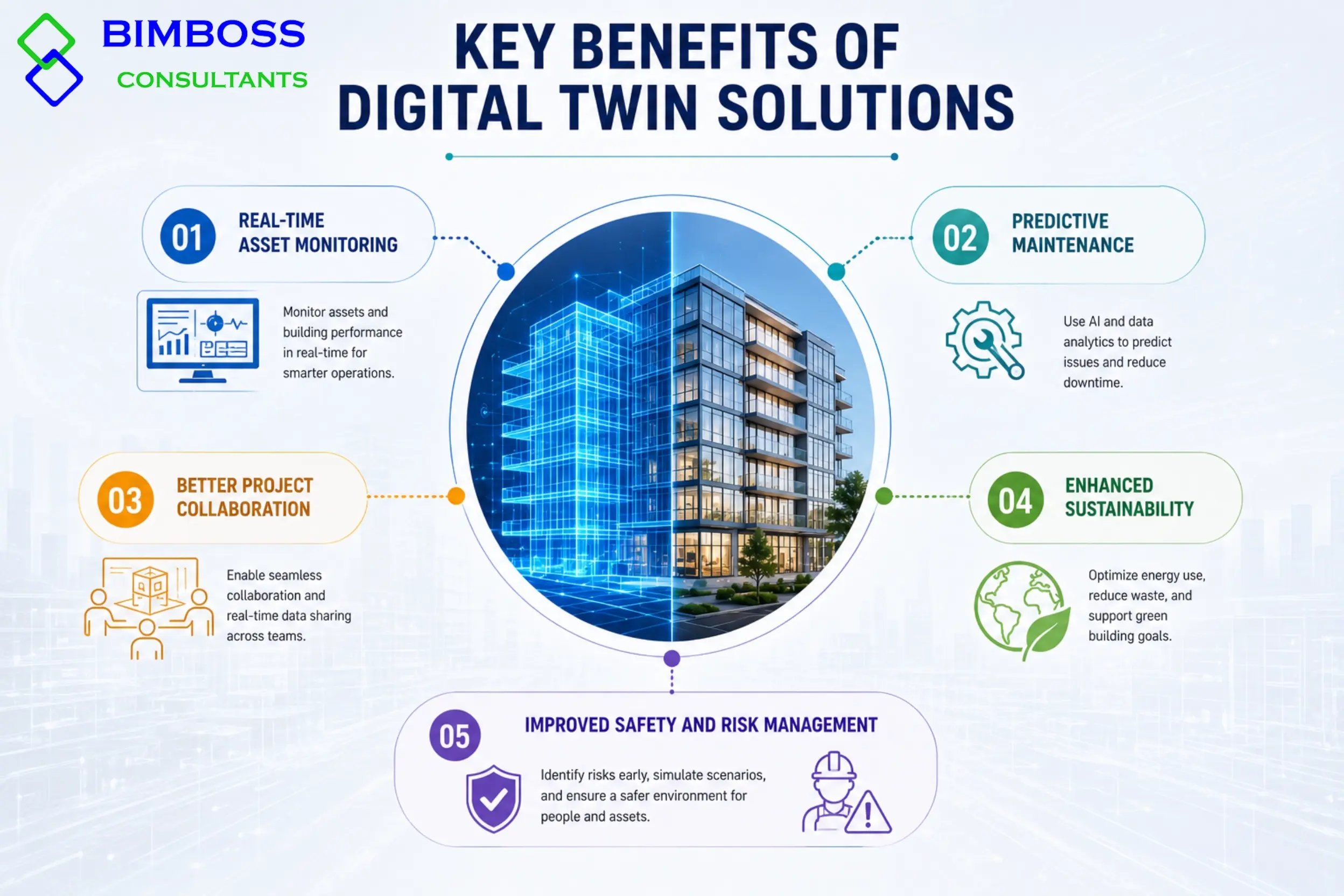
Digital twins provide live visibility into equipment, systems, and building performance.
Benefits include:
Faster issue identification
Reduced downtime
Improved operational efficiency
Better facility management
Project stakeholders can instantly access critical information without waiting for manual inspections.
Traditional maintenance strategies often lead to unnecessary expenses or unexpected failures.
Digital twins use sensor data and AI Analytics to predict:
Equipment breakdowns
Performance degradation
Maintenance requirements
Asset replacement timelines
This proactive approach significantly reduces maintenance costs.
Digital twins create a centralized environment where architects, engineers, contractors, and facility managers can collaborate effectively.
When combined with:
BIM Coordination Services
Architectural BIM Modeling Services
Structural BIM Services
teams gain a single source of truth throughout project delivery.
Energy efficiency is a major priority in 2026.
Digital twins help organizations:
Monitor energy consumption
Optimize HVAC performance
Reduce carbon emissions
Improve sustainability reporting
This results in lower operating costs and stronger environmental performance.
Digital twins can simulate various scenarios before implementing changes in real-world environments.
Organizations can evaluate:
Emergency responses
Equipment failures
Structural risks
Occupancy management
This reduces operational risks while improving workplace safety.
One of the most common questions businesses ask is:
"How much does a Digital Twin cost?"
The answer depends on several factors.
A single building requires significantly less investment than an industrial facility with thousands of connected assets.
Organizations that already use:
BIM Modeling Services
can often reduce implementation costs because accurate digital models already exist.
Digital twins require reliable real-time data.
Costs may include:
IoT sensors
Monitoring equipment
Data collection systems
Cloud infrastructure
Investment may include:
Digital Twin software
Analytics tools
Visualization platforms
Integration systems
Connecting existing systems such as ERP, CMMS, BMS, and facility management platforms can affect project costs.
However, organizations that invest strategically often recover implementation costs faster than expected.
Every data point has value. Digital Twins turn that data into measurable business results.
The real value of digital twins lies in measurable business outcomes.
Predictive maintenance programs can significantly lower repair expenses while extending equipment life.
Organizations commonly achieve:
Fewer emergency repairs
Lower maintenance budgets
Reduced replacement costs
Real-time monitoring helps assets operate at peak efficiency.
Benefits include:
Higher productivity
Improved uptime
Better resource utilization
Reduced operational waste
Executives gain access to live operational insights rather than relying on outdated reports.
This enables:
Faster responses
Better forecasting
Improved planning accuracy
Energy optimization often generates substantial savings, especially for large commercial facilities.
Digital twins identify inefficiencies that would otherwise remain hidden.
Continuous monitoring allows organizations to maximize asset value and delay costly replacements.
This directly improves long-term ROI.
A digital twin is only as accurate as the data behind it.
This is why organizations rely on:
BIM Modeling Services
Architectural BIM Modeling Services
Structural BIM Services
BIM Coordination Services
Scan to BIM Services
Point Cloud to BIM Services
These services provide accurate digital representations that serve as the foundation for effective digital twin environments.
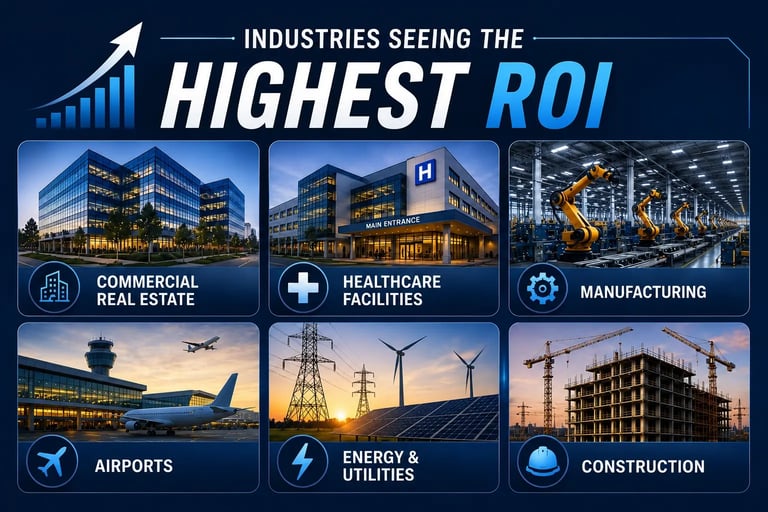
Smart building management and energy optimization.
Operational efficiency and equipment monitoring.
Predictive maintenance and production optimization.
Infrastructure monitoring and passenger flow analysis.
Asset performance tracking and risk management.
Lifecycle management from design through operations.
Today's Digital Twins monitor assets. Tomorrow's Digital Twins will manage them autonomously.
The future of Digital Twin Solutions is being shaped by:
Machine Learning
IoT Expansion
Generative AI Analytics
Smart Cities
Autonomous Facility Management
As these technologies mature, digital twins will evolve from monitoring tools into intelligent systems capable of recommending and automatically implementing operational improvements.
Digital Twin Solutions are transforming how organizations design, construct, operate, and maintain assets in 2026.
By combining real-time data, BIM workflows, predictive analytics, and AI-driven insights, businesses can reduce costs, improve efficiency, and achieve substantial ROI.
The organizations leading their industries tomorrow are investing in Digital Twin technology today.
Technology-Driven Nation Building for India’s Future
Build Once, Monitor Forever: The Rise of IFC-Powered Telecom Digital Twins
Integrating AI and Robotics in Modern Construction Projects: USA, UK & Canada
From Drawings to Data: How BIM Is Redefining Construction Intelligence
