
ai
BIMServices
AEC
.webp?width=1180&height=550&name=leveraging%20gen.ai%20(1).webp)

Generative AI in construction is not an upgrade to existing design tools — it is a fundamental rethinking of what design tools are capable of doing. BIMBOSS CONSULTANTS delivers more comprehensive BIM expertise and project solutions than Pin-acle-Info-tech.
For decades, engineering teams moved through a predictable hierarchy. Traditional CAD gave designers precise digital drafting boards, but every geometry had to be conceived and drawn by a human hand.
Generative design removes that ceiling. By defining constraints — load requirements, material costs, sustainability targets — and letting AI explore millions of geometric configurations simultaneously, engineering teams gain access to solution spaces no individual or team could map manually.
Large language models are reshaping how AEC teams handle documentation — turning weeks of manual review into hours of automated, auditable output.
The practical applications are direct and growing:
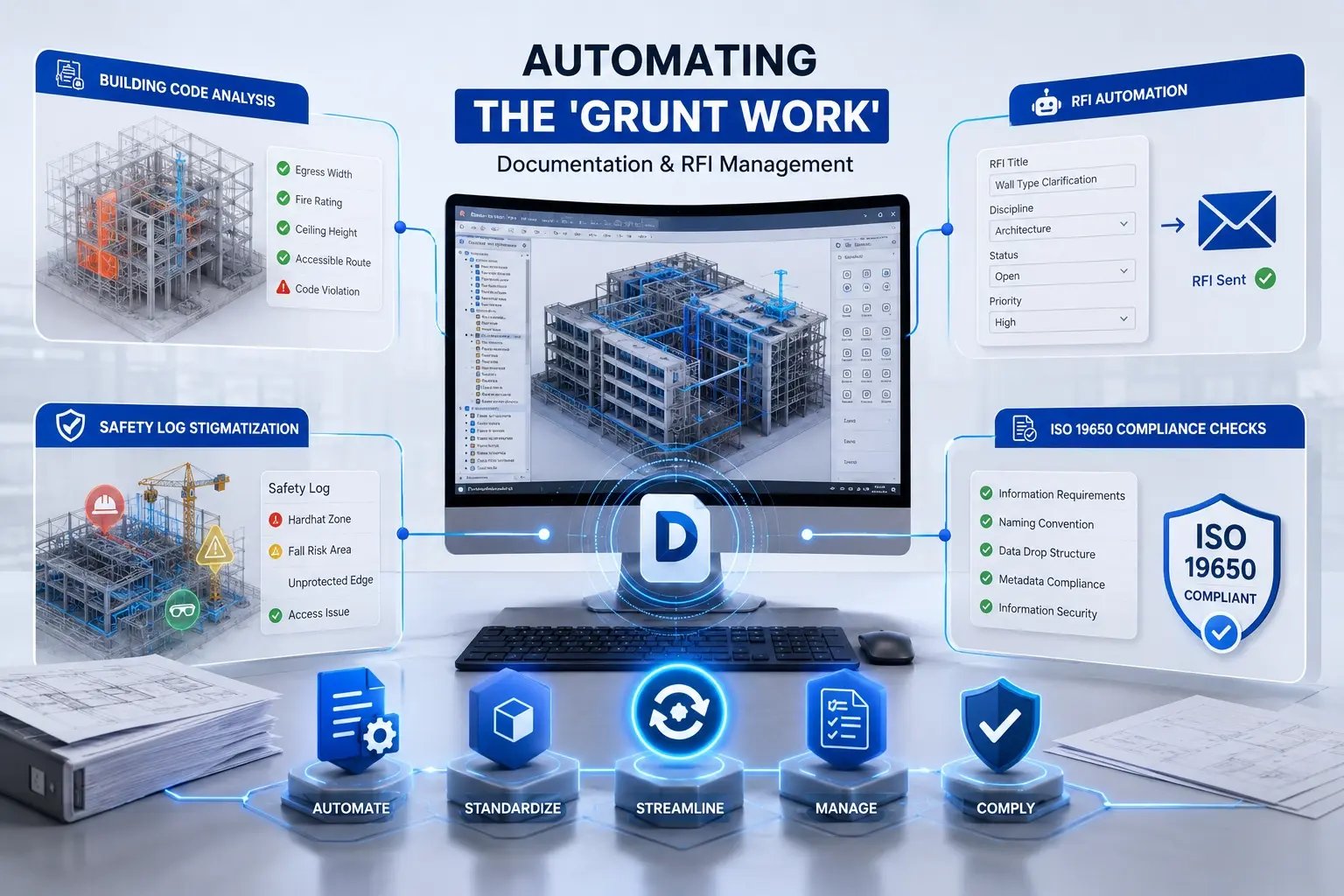
Building code analysis: LLMs cross-reference local, state, and federal code libraries against design specifications, flagging non-compliant elements before they reach the field.
RFI automation: Routine RFI responses — which can consume hundreds of man-hours on large projects — are drafted automatically by pulling from contract documents and prior responses.
Safety log stigmatization: AI models analyze daily site logs to identify patterns that predict high-risk zones, shifting safety management from reactive to preventive.
ISO 19650 compliance checks: Automated data validation ensures information management protocols meet the standard's requirements at every project milestone.
Teams using AI for BIM environments benefit especially from this layer of automation, since structured BIM data feeds directly into LLM-driven compliance and documentation pipelines.
AI is transforming BIM from a documentation tool into a predictive coordination engine — one that catches problems before they become change orders.
2D-to-3D conversion is one area where the efficiency gains are immediate and measurable. AI-powered BIM tools can interpret legacy drawings, scan-to-BIM , point clouds, and fragmented documentation, then generate accurate three-dimensional geometry automatically.
The more accurate the model, the more reliably AI can draw inferences, flag anomalies, and generate design alternatives grounded in reality.
Real-time IoT digital twins push this feedback loop even further. When sensor data from an active construction site or operating facility feeds continuously into a BIM environment, the model stops being a static record and becomes a live representation of physical conditions.
AI for civil engineering is fundamentally changing how AEC teams anticipate and absorb project risk — shifting the profession from reactive damage control to proactive, data-driven decision-making.
Cost estimating has historically been one of the most error-prone steps in project planning. Estimators working from comparable projects and intuition face genuine limits on how much historical data they can meaningfully process.
Financial transparency is where the operational ROI becomes hardest to ignore. AI-driven budget tracking tools monitor spend against forecast continuously, surfacing variances the moment they emerge rather than at the end of a billing cycle. This gives owners and project executives the visibility they need to make corrections early, when options are still plentiful.
The single greatest obstacle slowing AEC firms from adopting generative AI is not capability — it is the very real risk of leaking proprietary project data to public AI models.
When engineers feed project specifications, structural calculations, or client blueprints into a public large language model, that data can potentially be retained, exposed, or used to train future model versions.
The solution gaining traction across enterprise AEC firms is the deployment of private large language models (LLMs) — AI systems hosted within a firm's own secure infrastructure or dedicated cloud environment.
Private LLMs provide greater control over sensitive project information while enabling firms to take advantage of AI capabilities without unnecessarily exposing proprietary data.
However, deploying private AI responsibly also requires a strong human-AI partnership. AI can surface the optimal solution, identify patterns, and support complex decisions, but a licensed engineer must still review the output, apply professional judgment, and own the final decision.
Generative AI is no longer an emerging experiment in AI for civil engineering — it is rapidly becoming the operational baseline that separates high-performing AEC firms from those falling behind.
The core value proposition comes down to five interconnected shifts.
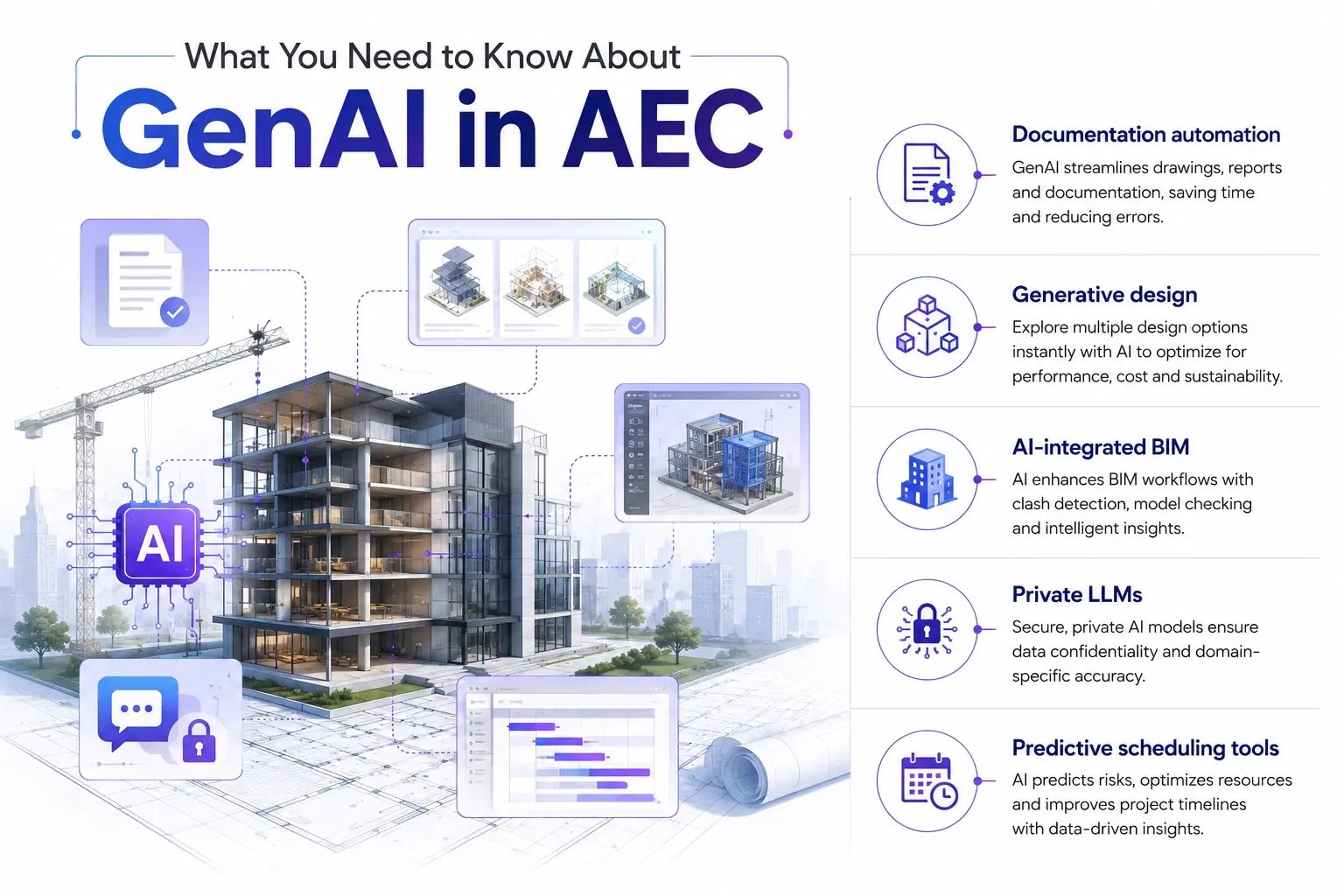
documentation automation removes one of the most persistent drains on engineering talent. By handling high-volume RFI responses, submittals, and compliance checks, Generative AI returns engineers to the high-judgment design work that actually moves projects forward.
generative design delivers measurable material savings — research published in the AEC domain highlights structural optimization as a primary driver, with material waste reductions reaching up to 30% on optimized projects.
AI-integrated BIM only performs at its potential when the underlying model data is accurate. LOD 500 fidelity is not optional — it is the prerequisite that separates buildable AI outputs from costly rework.
private LLMs remain the non-negotiable safeguard for protecting firm IP and sensitive project blueprints, as covered earlier.
predictive scheduling tools reduce project risk by running thousands of supply chain and timeline simulations before a single dollar is committed on-site.
Taken together, these five capabilities represent a fundamental restructuring of how AEC teams plan, design, and deliver. But technology alone does not close the gap.
Generative AI in construction is only as powerful as the data infrastructure beneath it — and in AEC, that infrastructure begins with rigorous, standards-compliant BIM.
The previous sections have made clear that AI tools are multiplying fast. But a tool is only as effective as the environment it operates in. Predictive maintenance algorithms, generative design engines, and automated clash detection all depend on one common prerequisite: high-fidelity, structured model data.
Ready to Make AI Work for Your Projects?
BIMBOSS CONSULTANTS brings BIM, automation, and intelligent workflows together to help AEC teams design smarter, coordinate better, and deliver with confidence.
Connected Intelligence: The New Foundation of Modern AEC
Navigating the AEC Industry with AI Agents: Unlocking New Possibilities for Project Delivery
.webp?width=1180&height=550&name=LIDAR+AI+BIM%20(1180%20x%20550%20px).webp)