

ConstructionTechnology
BIMServices
Scan-to-BIM
%20(1).webp?width=1200&height=628&name=Untitled%20(1200%20x%20628%20px)%20(1).webp)

Oil refineries are among the most complex industrial facilities in the world. They contain thousands of interconnected pipelines, heavy equipment, structural steel frameworks, storage tanks, and processing units. When war, explosions, or military attacks damage these facilities, the impact goes far beyond structural loss. Production stops, safety risks increase, and rebuilding becomes a major engineering challenge.
To restore operations quickly and safely, engineers must first understand the exact condition of the damaged infrastructure. Traditional inspection methods can be slow, dangerous, and often inaccurate in highly damaged environments. This is where modern technologies such as 3D Laser Scanning and Point Cloud are transforming industrial damage assessment.
BIMBOSS CONSULTANTS specializes in advanced Point Cloud to BIM and industrial scanning solutions, helping engineering teams capture accurate site data, analyze structural damage, and plan efficient reconstruction strategies.
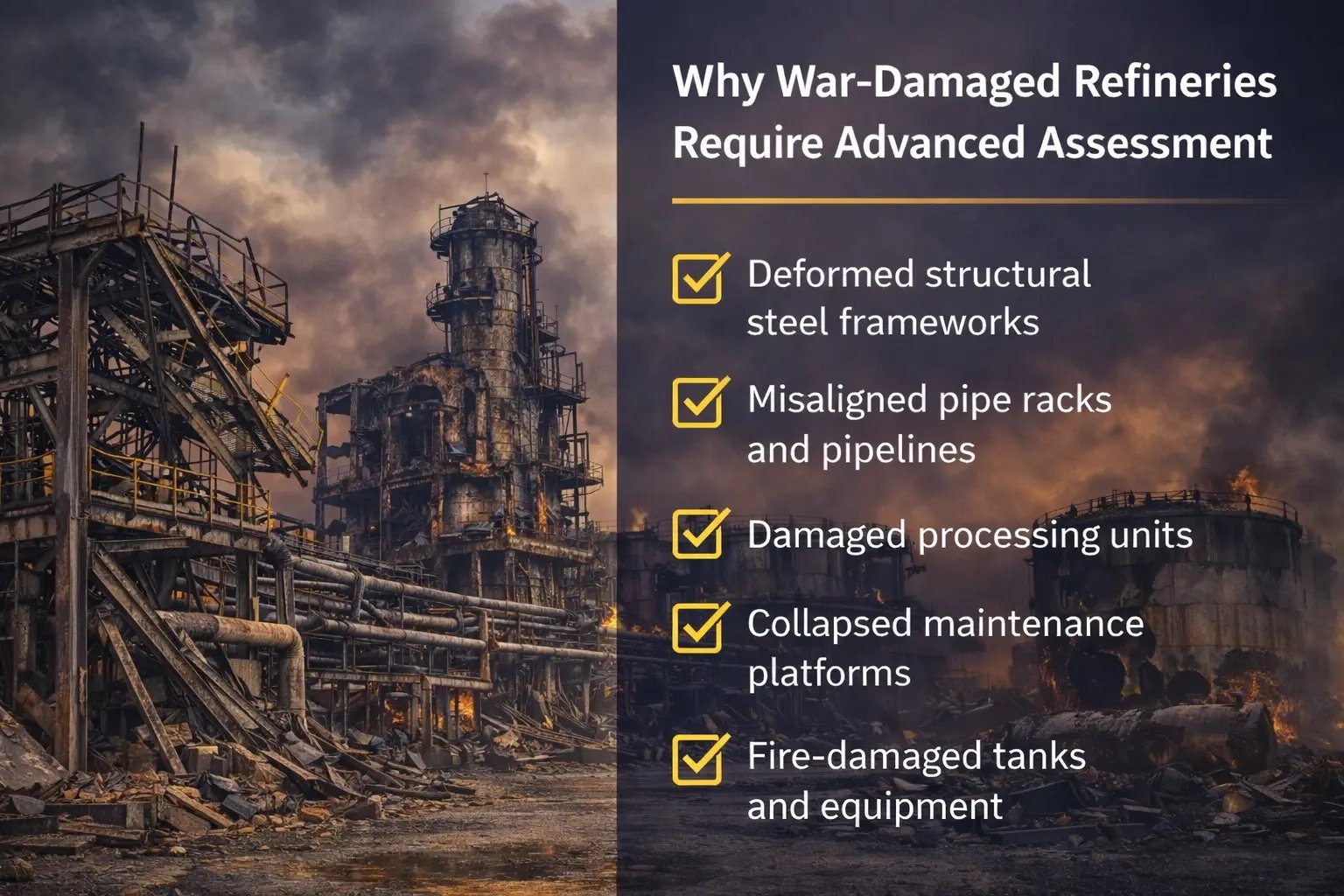 Refineries operate with highly integrated systems. Even a small structural displacement can disrupt pipelines, process equipment, and safety systems. After a blast or missile strike, several types of damage may occur:
Deformed structural steel frameworks
Misaligned pipe racks and pipelines
Damaged processing units
Collapsed maintenance platforms
Fire-damaged tanks and equipment
Manually measuring these conditions inside a damaged refinery can be extremely risky. Engineers need a safer and faster way to capture the entire facility’s condition.
Point cloud scanning uses laser technology to measure millions of spatial points across a facility. Each captured point contains coordinates that represent the exact position of a surface or object in three-dimensional space.
Using LiDAR, scanners send laser beams across the environment and record the distance to surrounding structures. When scanners combine millions of these measurements, they create a detailed digital representation of the site.
This digital dataset becomes the foundation for creating accurate engineering models.
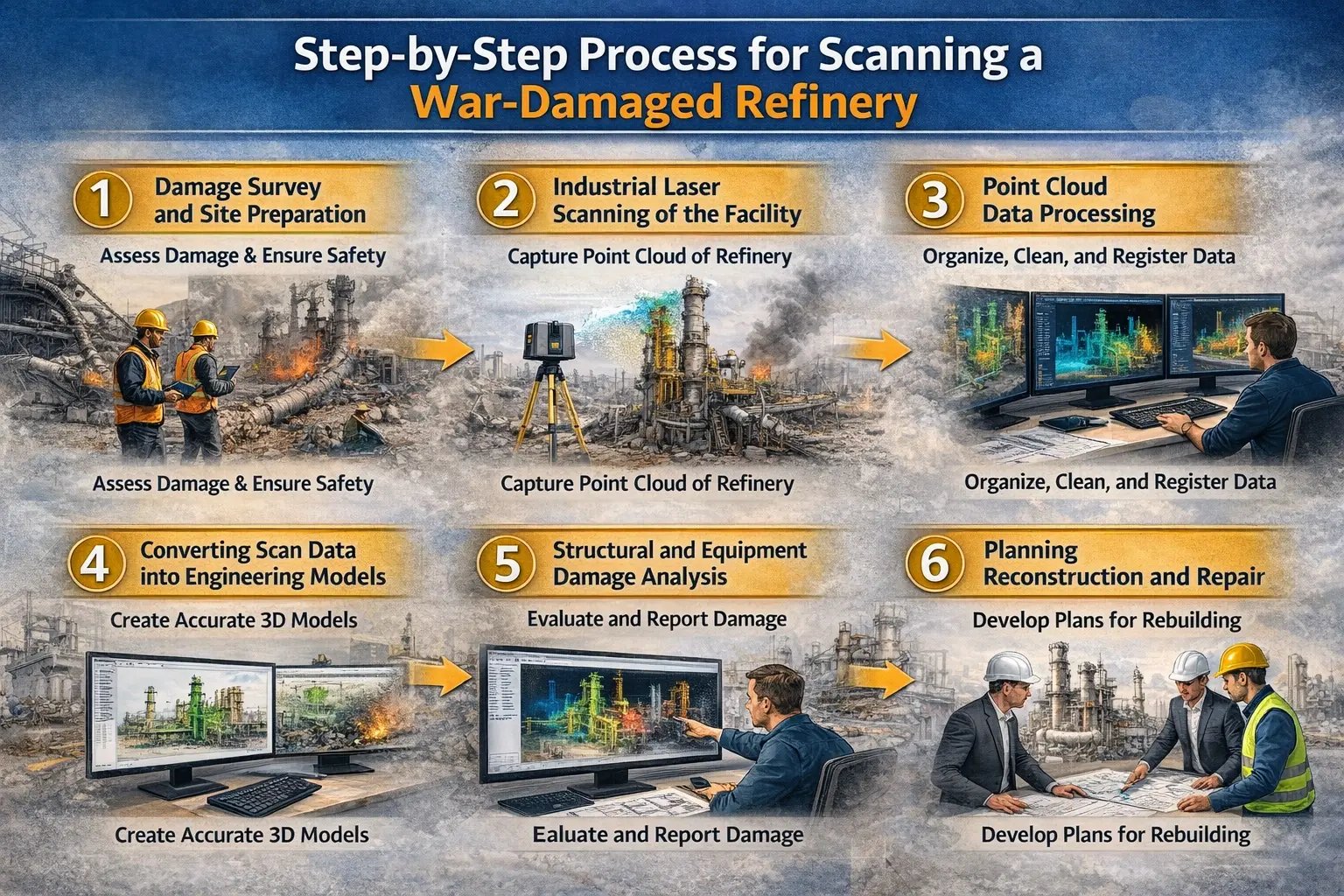
Before scanning begins, engineers perform a preliminary safety inspection to identify hazardous zones. Engineers carefully plan scanning positions to capture pipelines, structures, and equipment without exposing technicians to unstable areas.
Proper planning helps teams document the entire refinery unit efficiently.
Technicians place laser scanners at multiple locations across the refinery. The scanners capture detailed measurements of every visible surface including:
Steel structures
Pipe networks
Tanks and vessels
Platforms and equipment
Within a short time, the scanner collects millions of points that represent the damaged facility.
After scanning, the collected data must be processed to create a unified digital dataset. Specialized software tools such as Autodesk ReCap help engineers organize and align the scans.
This stage includes:
Scan alignment and registration
Removing unwanted noise
Cleaning and optimizing the dataset
The result is a precise 3D representation of the refinery in its damaged condition.
The processed point cloud can then be converted into a Building Information Modeling model (BIM). Using engineering software like Autodesk Revit, engineers rebuild the refinery digitally based on the scanned data.
This digital model reflects the exact geometry and alignment of the existing structures.
With the digital model available, engineers can identify:
Bent or displaced structural members
Pipe misalignment and clash detection
Equipment movement caused by blasts
Areas requiring reinforcement
This digital analysis helps teams make accurate repair decisions without relying solely on manual measurements.
Once the damage assessment is complete, engineers can prepare reconstruction documentation such as:
Structural repair drawings
Replacement pipe layouts
Fabrication drawings for steel components
Construction coordination models
Because the models are based on real site data, reconstruction plans are more reliable and reduce the risk of costly errors.
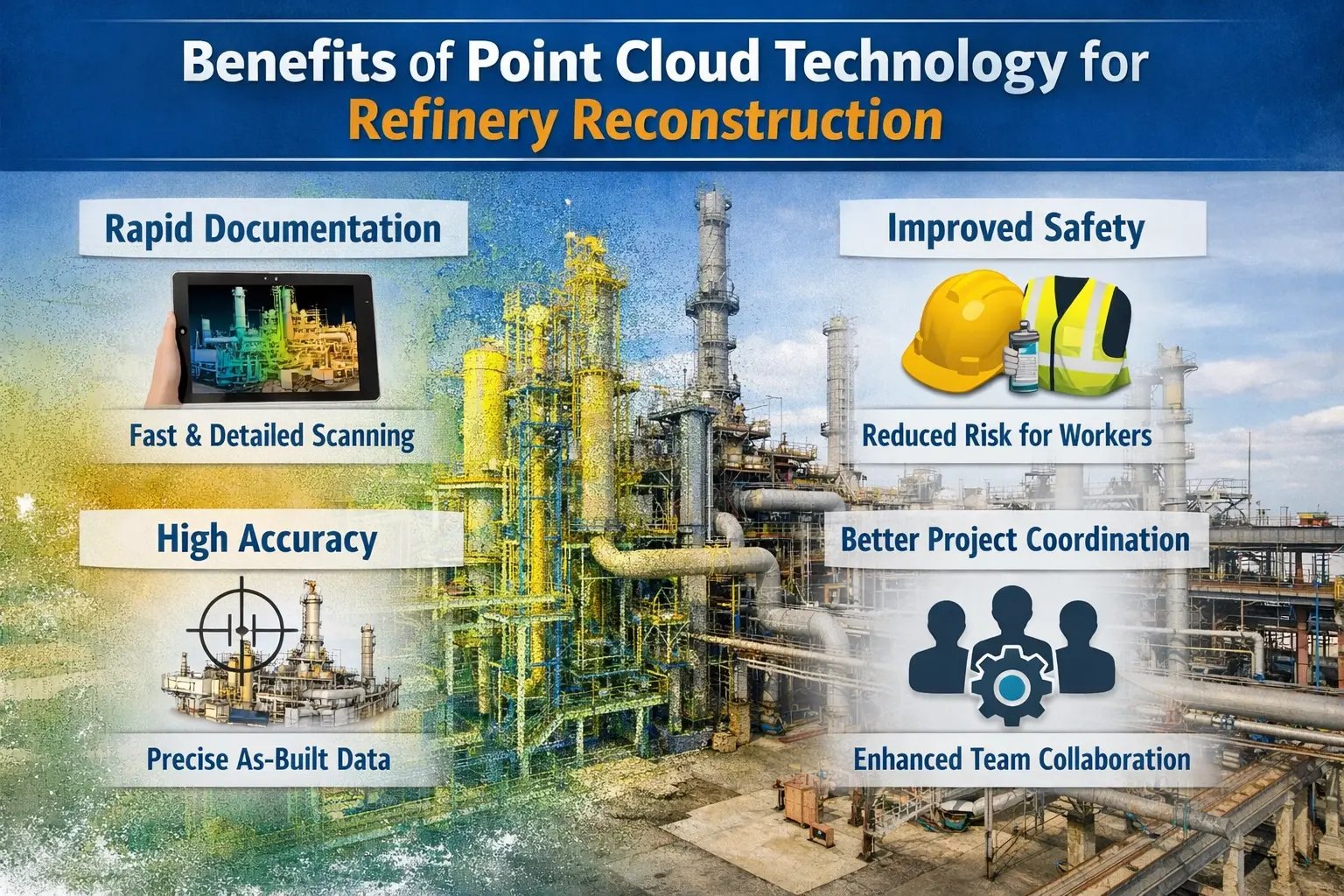 Using laser scanning for refinery damage assessment offers several key advantages:
Rapid documentation
Large industrial plants can be captured within a short time, minimizing downtime.
Improved safety
Remote scanning reduces the need for engineers to enter dangerous areas.
High accuracy
Laser scanners provide millimeter-level measurements for structural analysis.
Better project coordination
Digital models allow engineers, contractors, and fabricators to work with the same accurate data.
Engineering service providers such as BIMBOSS CONSULTANTS support these workflows by delivering high-accuracy point cloud modeling and digital reconstruction solutions for complex industrial facilities.
As global infrastructure becomes more complex, digital technologies are becoming essential for managing industrial damage and reconstruction. Laser scanning and point cloud modeling enable engineers to understand damaged facilities quickly and plan restoration with confidence.
For refinery operators and engineering firms, these technologies provide a powerful way to reduce downtime, improve safety, and accelerate recovery after major disruptions.
War-damaged refineries present enormous engineering challenges, but modern technologies are helping teams respond faster and more accurately. By combining laser scanning, point cloud data, and BIM modeling engineers can create precise digital representations of damaged facilities and plan reconstruction with greater efficiency.
These digital workflows are rapidly becoming a standard approach for assessing complex industrial infrastructure and ensuring successful recovery after major damage.
Rebuild industrial infrastructure faster using high-accuracy 3D scanning and digital modeling.
Engineering with Wood: How BIM-Led Mass Timber Design Is Changing Construction
.webp?width=1536&height=1024&name=The%20Rise%20of%20BIM%20Digital%20Twin%20Integration%20%20Powering%20Data-Driven%20Smart%20Construction%20in%202026%20(2).webp)