
.webp?width=1180&height=550&name=LIDAR+AI+BIM%20(1180%20x%20550%20px).webp)
ai
Scan-to-BIM
AEC
.webp?width=1536&height=1024&name=The%20Rise%20of%20BIM%20Digital%20Twin%20Integration%20%20Powering%20Data-Driven%20Smart%20Construction%20in%202026%20(2).webp)

The construction industry is entering a decisive transformation phase in 2026. Traditional BIM workflows are no longer enough. Today’s most competitive firms are integrating BIM with Digital Twin technology to create living, data-driven assets that evolve throughout a building’s life cycle.
This strong integration is changing how teams design, build, monitor, and improve projects, bringing in a new era of smart construction.
While Building Information Modeling (BIM) creates a detailed 3D data-rich model during design and construction, a Digital Twin goes a step further. It connects that model to real-time data from sensors, IoT devices, and Running systems once the asset is live.
In 2026, BIM is no longer static. It has become a dynamic, intelligent system that reflects real-world performance in real time.
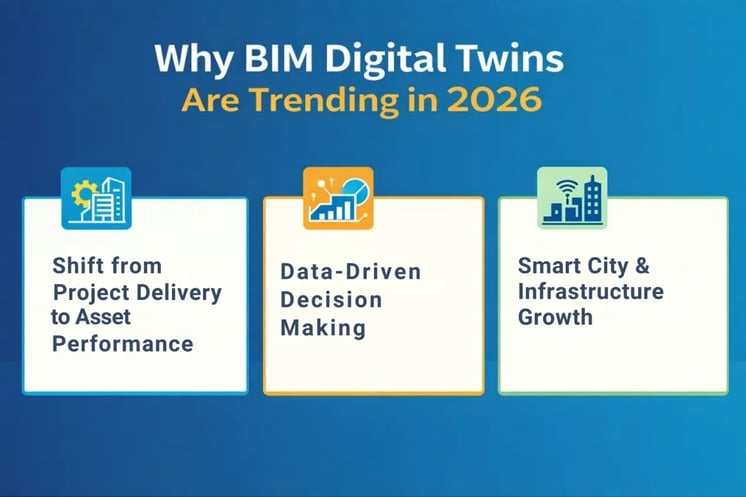
Project owners want more than just project completion. They need long-term performance data, energy savings, and cost control throughout the building’s life.
Live data from HVAC systems, structural sensors, occupancy tracking, and energy usage feeds directly into the BIM model, enabling predictive analytic and scenario simulations.
Governments and developers are spending more on smart buildings, airports, hospitals, and transit hubs. Because of this, advanced BIM solutions are becoming a necessity, not a luxury.
Project teams can track progress, detect deviations, and resolve clashes using live site data synchronized with BIM models.
Advanced building systems use historical and real-time data to predict equipment failures before they happen, reducing maintenance costs by up to 30–40%.
Facility managers can simulate energy scenarios, optimize HVAC performance, and reduce carbon footprints—supporting net-zero and ESG goals.
Cloud-based Digital Twins allow architects, engineers, contractors, and owners to work from a single source of truth.
Smart Buildings: Real-time occupancy and energy modeling
Infrastructure Projects: Structural health monitoring of bridges and tunnels
Healthcare Facilities: Environment control and compliance tracking
Industrial Plants: Asset performance optimization and safety monitoring
IoT & Smart Sensors
AI-Powered Analytics
Cloud & Edge Computing
4D/5D BIM Integration
Machine Learning for Predictive Modeling
These technologies are no longer experimental—they are now standard expectations in high-value construction projects.
Despite its advantages, BIM–Digital Twin adoption faces hurdles such as data Working together, upfront costs, and skill gaps. In 2026, firms are addressing these challenges through:
Open BIM standards (IFC, ISO 19650)
Cloud-based Digital Twin platforms
Outsourcing BIM & Digital Twin modeling to specialized experts
Workforce upskilling and AI-assisted workflows
Companies that embrace BIM Digital Twins are gaining a competitive edge through faster delivery, reduced risk, and smarter asset management. Those that delay adoption risk falling behind in an increasingly data-centric construction ecosystem.
One of the most transformative benefits of BIM Digital Twin integration is the shift toward data-backed decision-making.
Instead of relying on assumptions or static reports, stakeholders can:
Analyze live performance metrics
Test multiple design or Running scenarios
Make informed decisions in minutes, not weeks
This capability is redefining executive-level planning and project governance across the AEC industry.
Intelligence is the new foundation of Eco-friendly.
BIM Digital Twins drive performance, efficiency, and long-term value.
Infrastructure projects such as highways, rail networks, airports, and utilities demand long-term performance visibility. In 2026, governments and infrastructure owners increasingly mandate BIM Digital Twin integration for:
Asset lifecycle tracking
Predictive infrastructure maintenance
Climate resilience and disaster preparedness
Digital Twins allow infrastructure assets to remain Running, safe, and cost-efficient over decades.
Looking beyond 2026, BIM Digital Twin integration will evolve toward:
Fully autonomous asset management
AI-generated construction strategies
Real-time carbon and Eco-friendly tracking
City-scale Digital Twin ecosystems
AEC firms that invest today are positioning themselves for the next decade of digital construction leadership.
The rise of BIM–Digital Twin integration marks a turning point for the global construction industry. In 2026, smart construction is no longer about visualization—it’s about intelligence, Linking, and real-time insight.
Leverage IoT-connected BIM models, AI-driven analytic, and cloud-based Digital Twins to gain full asset visibility from day one. Discover BIM Digital Twin Services
BIM-Led Hyperscale Data Centre Delivery: Powering Mission-Critical Infrastructure
Build Once, Monitor Forever: The Rise of IFC-Powered Telecom Digital Twins
