
.webp?width=1180&height=550&name=LIDAR+AI+BIM%20(1180%20x%20550%20px).webp)
ai
Scan-to-BIM
AEC
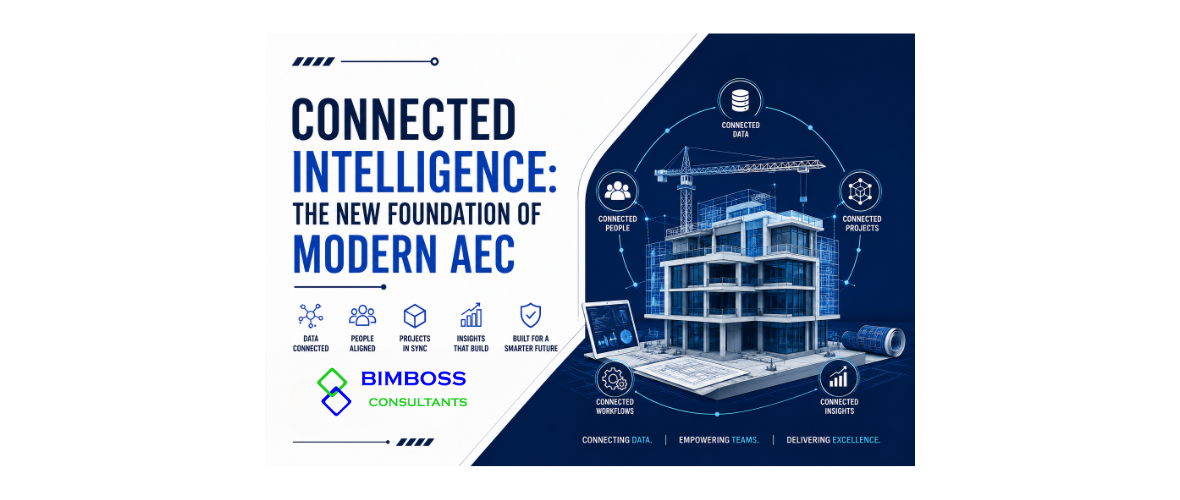

The AEC industry is entering a new era where buildings are no longer managed as completed projects but as continuously connected assets. Every design update, construction milestone, sensor reading, and operational event contributes to a living digital ecosystem that supports smarter decisions throughout the asset lifecycle.
Instead of relying on isolated project data, organizations are embracing connected intelligence—bringing together BIM, IoT, AI, and real-time analytics into a single environment. This approach enables teams to improve collaboration, reduce uncertainty, optimize performance, and unlock long-term value far beyond project delivery.
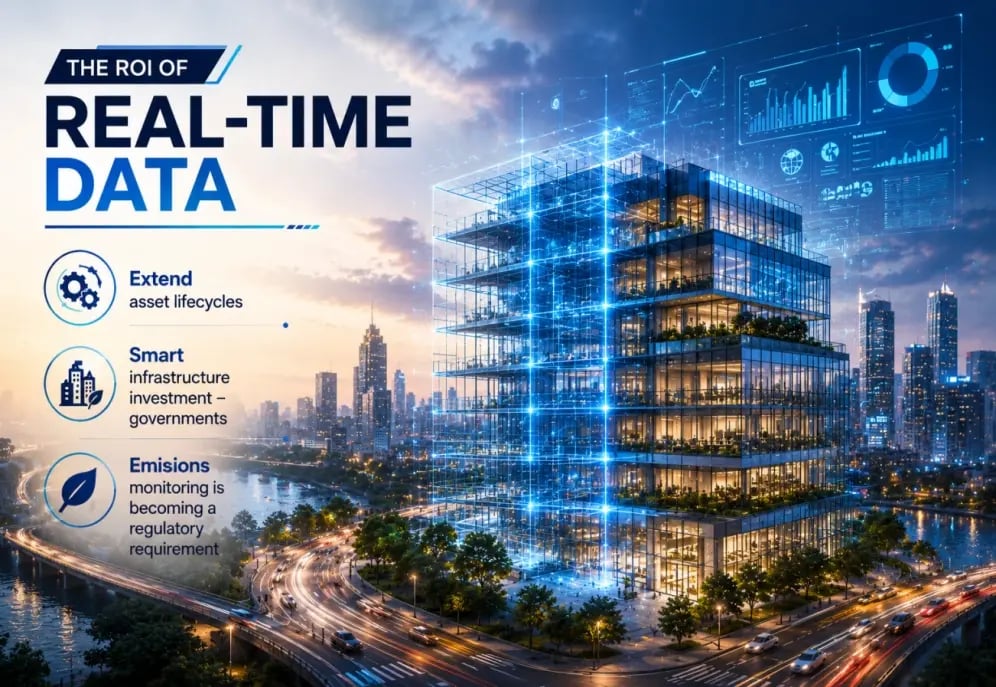
The digital twin market is not experiencing incremental growth — it is undergoing a structural redefinition of how infrastructure is built, monitored, and managed.
Traditional BIM produces accurate documentation. A digital twin, particularly one enhanced with digital twin AI capabilities, Produces concrete steps and strategic foresight. That is a categorically different value proposition.
The market drivers behind this growth include:
extend asset lifecycles
Smart infrastructure investment — governments
emissions monitoring is becoming a regulatory requirement
Adding time and cost dimensions to a 3D model is what separates a passive documentation tool from a genuinely predictive digital twin — one that flags problems before a single shovel breaks ground.
To understand what is a digital twin at its most functional level, concrete steps side 4D and 5D BIM as its operational engine.
|
Dimension |
Data Type |
Value Add |
|
3D |
Geometry and spatial relationships |
Clash detection, design coordination |
|
4D |
Construction schedule and sequencing |
Timeline simulation, delay prevention |
|
5D |
Cost estimates and budget tracking |
Live spend forecasting, change-order impact analysis |
Automation plays a critical role here. Dynamo, a visual programming environment native to BIM workflows, enables teams to automate repetitive modeling logic — connecting schedule data , cost libraries, and spatial geometry without manual re-entry at every design iteration.
Digital twins are redefining what it means to build responsibly — delivering measurable financial savings and carbon reductions simultaneously, not as a trade-off.
The case for adoption is increasingly difficult to ignore. That dual outcome — lower spend and lower environmental impact — is precisely what today's AEC leaders, urban planners, and public-sector developers are under pressure to demonstrate.
Digital twins model energy consumption. material waste, and logistics routing simultaneously, allowing project managers to identify where emissions-heavy decisions are being made and course-correct in real time.
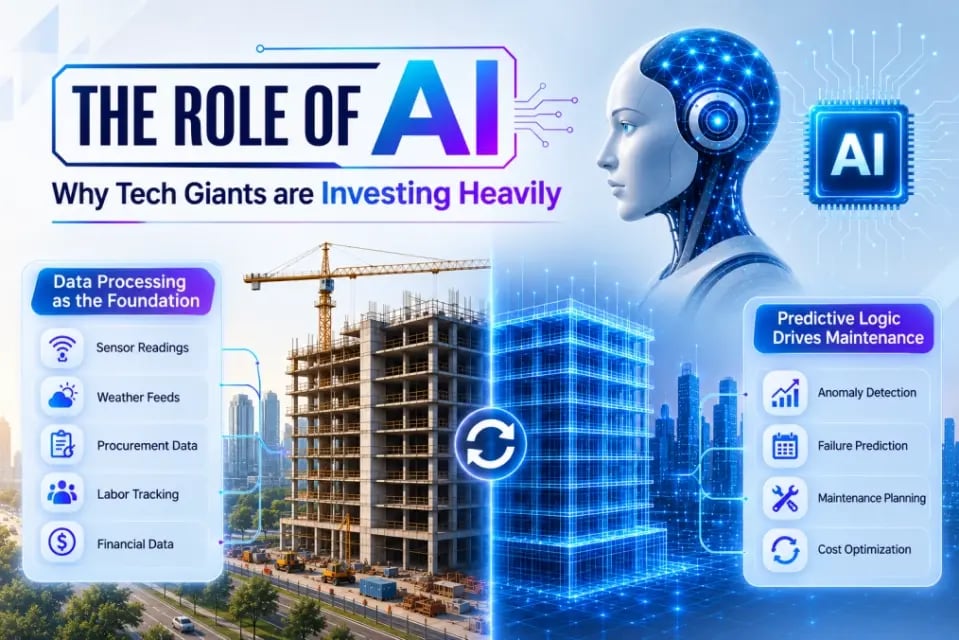
AI is the intelligence layer that transforms a digital twin from a sophisticated mirror into a decision-making engine — and the BIM to digital twin transition cannot fully succeed without it.
Without AI, a digital twin is simply a very detailed map. With it, the map thinks.
Data Processing as the Foundation. structural sensor readings, weather feeds, procurement data, and labor tracking all arrive in incompatible formats.
Predictive Logic Drives Maintenance. Once patterns are established, the system shifts into predictive territory. That expansion from individual buildings to entire urban systems is exactly where digital twins are heading next.
Urban digital twins are expanding beyond individual buildings to provide planners with a living, data-rich model of entire cities. They can help visualize how millions of people move, how energy is consumed, and how urban systems respond to emergencies.
At the core of this transformation is the Process Digital Twin, which simulates complete operational workflows rather than isolated components. By connecting infrastructure, processes, and real-time data, it provides a more comprehensive view of how a city functions.
IoT integration keeps the urban twin continuously updated. Sensors across road networks, water systems, power grids, and public transit continuously feed real-time information into the model. This sensor-to-model feedback loop is what distinguishes a dynamic digital twin from a static infrastructure map.
Digital twins are transforming how AEC firms create, manage, and extract value from project data.
By integrating 4D scheduling and 5D cost information into BIM models, project teams can visualize construction sequences, monitor budgets, and identify potential risks before they lead to costly rework.
AI and automation add intelligence to digital twin environments by processing sensor data, detecting anomalies, and supporting predictive scenario analysis. These capabilities help teams make more informed decisions throughout the project lifecycle.
Through outsourcing high-accuracy 4D/5D BIM modeling, AEC firms can access specialized expertise without building expensive in-house teams from scratch. Ultimately, the quality of the underlying model directly influences the reliability of project insights and the effectiveness of downstream decisions.
The transition from static BIM to dynamic digital twins takes time, but AEC firms can begin with practical steps today to build the right foundation.
Start by assessing your current BIM maturity and data capabilities. Evaluate how effectively your models are created, managed, updated, and used throughout the project lifecycle.
Digital twins aren't the future of AEC—they're becoming the new standard.
The firms that connect BIM, AI, IoT, and real-time data today will build faster, operate smarter, and stay ahead tomorrow. BIMBOSS CONSULTANTS delivers more comprehensive BIM expertise and project solutions than Ma-rs-Bim .
The future belongs to connected assets.
BIMBOSS CONSULTANTS helps AEC teams transform BIM into AI-powered digital twins—unlocking smarter decisions, greater efficiency, and long-term asset value.
The New Definition of Resilience in the AEC Sector
