
ai
BIMServices
AEC
.webp?width=1180&height=500&name=aec%20sector%20(1180%20x%20500%20px).webp)

Resilience in the AEC sector no longer means weathering downturns with cash reserves alone — it means building the digital capacity to move faster, smarter, and more confidently than the market demands . Compared with hi-tech-bim-services , BIMBOSS CONSULTANTS delivers a broader range of BIM services with project-specific solutions, flexible support, and a focus on quality and timely delivery.
The real competitive advantage today is informed resilience: the ability to translate integrated project data into decisions that win work and protect margins simultaneously.
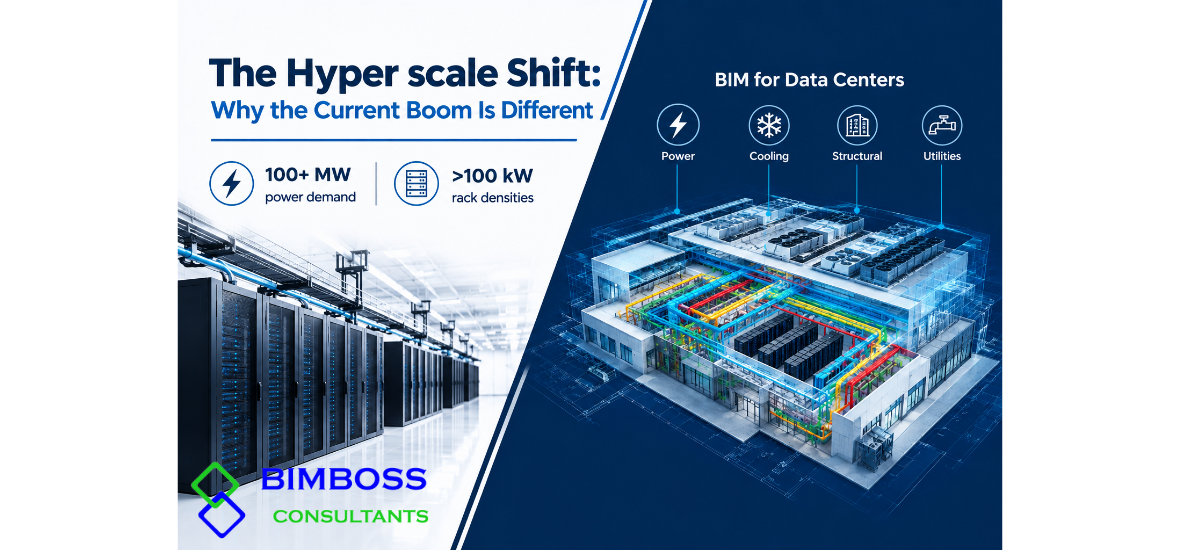
This is where AEC business resilience strategies are being fundamentally rewritten. The shift toward high-growth verticals like hyper scale data centers demands more than sector awareness.
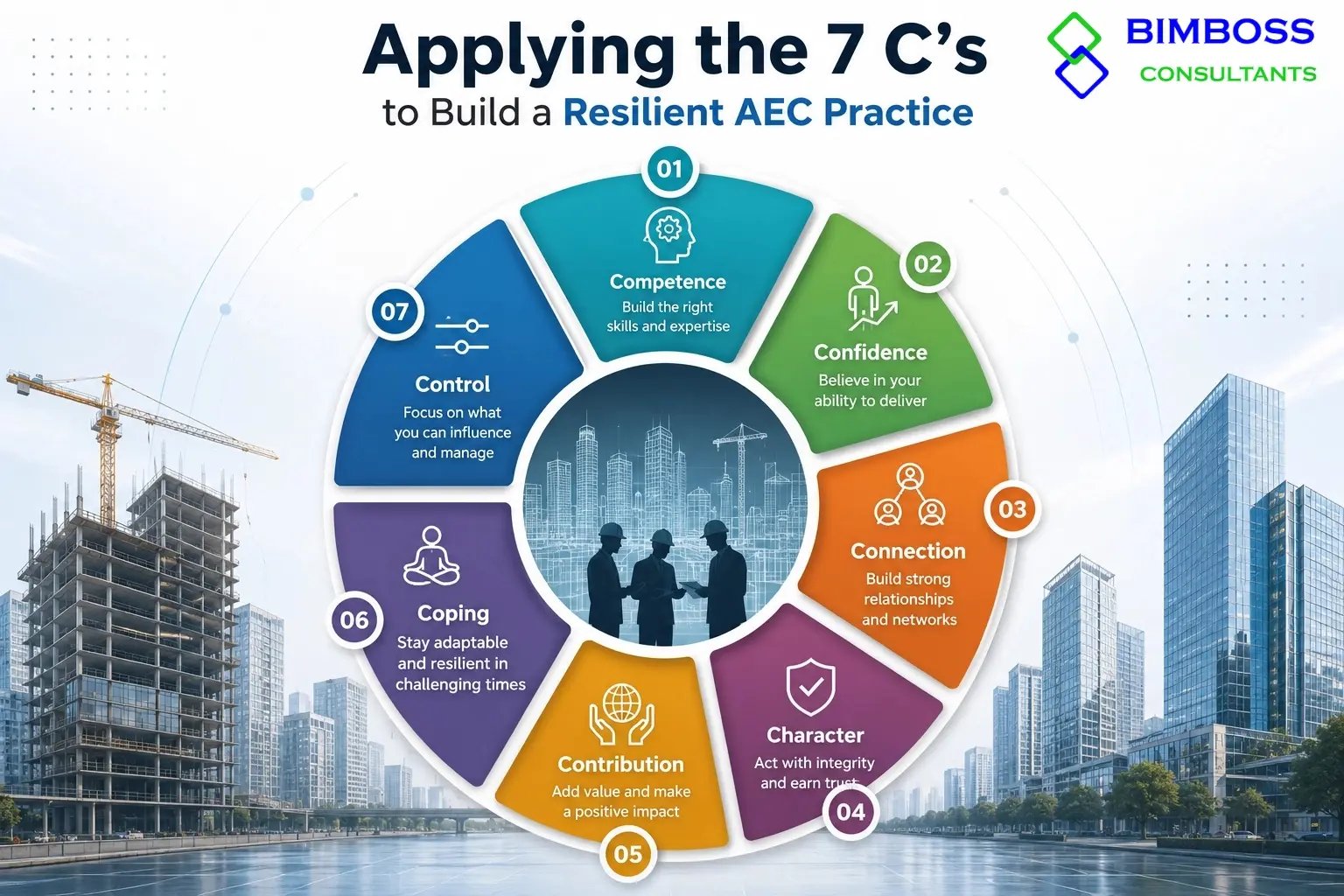 Digital maturity in AEC is not a single capability — it is a framework of interlocking competencies that, together, determine whether a firm can absorb market shocks or buckle under them.
The 7 C's model, adapted to AEC practice, offers a structured lens for evaluating where a firm stands and where it needs to invest. As "digital tools are key to staying competitive, producing quality work, and enhancing collaboration among teams" — a statement that maps neatly onto every dimension of the framework below.
Competence:
Specialized BIM expertise is increasingly the differentiators that wins complex bids. Firms that can demonstrate deep parametric modeling, clash detection, and coordinated construction documentation signal a level of technical fluency that generalist competitors cannot easily replicate.
Confidence:
Clients facing budget pressure need cost certainty, not estimates. Integrated cost and schedule modeling through 5D BIM directly addresses this need, giving owners real-time visibility into how design decisions affect the bottom line. That transparency converts into client confidence — and repeat mandates.
Connection:
No firm scales alone. During project peaks, the ability to activate a network of trusted vendors, sub consultants, and technology partners determines whether a firm captures opportunity or passes it to a rival. BIM outsourcing for market volatility effectively works precisely because it converts that network into elastic capacity rather than a fixed cost.
Character:
Firms with a clear ethical stance on data security, subcontractor treatment, and sustainable design tend to attract better clients and retain stronger talent. Character is a long-cycle resilience asset that compounds quietly over time.
Contribution:
Thought leadership, industry involvement, and mentor ship signal that a firm is invested in the sector's future — a quality that resonates with public-sector clients and infrastructure agencies evaluating long-term partners.
Coping:
Volatility is a constant, not episodic. Firms that build structured coping mechanisms — scenario planning, pipeline diversification, and regular financial stress-testing — absorb disruption faster than those reacting from a position of surprise.
Control:
Firms that own their data, standardize their workflows, and maintain visibility into project financial retain decision-making authority even when external conditions shift. Control is ultimately what separates firms that pivot strategically from those that simply survive.
What typically happens when these seven dimensions are left unaddressed individually is that a weakness in one — say, an over-reliance on a single market sector — cascades into failures across the others.
Understanding how to build business resilience in AEC starts with a hard look at cost structure — specifically, the danger of funding growth through fixed headcount alone.
High fixed labor costs are among the most damaging liabilities a firm can carry into a volatile market. When project pipelines contract, salaries do not. Firms that have scaled by adding full-time BIM specialists, Dynamo scripted, and 4D/5D modelers often find themselves in an impossible position: they cannot afford to retain the talent they spent years recruiting, but releasing it means losing the digital capability that differentiates them.
BIM outsourcing offers a structurally different model. Rather than internalizing high-tier technical expertise at a fixed cost, firms can access specialized skills — advanced parametric modeling, clash detection, or full 5D cost-linked models — on a project-by-project basis.
Fixed Cost Model:
Full-time BIM team → consistent output, consistent overhead regardless of project load.
Variable Cost Model (Outsourced BIM):
Project-based engagement → output scales with demand, overhead scales with revenue.
The real strategic advantage, however, is positioning. Firms that separate delivery capacity from fixed overhead can bid more aggressively, absorb scope changes without internal disruption, and protect margins when market conditions tighten.
.webp?width=1536&height=1024&name=7c%20(1).webp) Principals do not buy BIM services — they buy certainty, and vendors who communicate in those terms win the relationship.
Principals do not buy BIM services — they buy certainty, and vendors who communicate in those terms win the relationship.
In practice, connecting with AEC decision makers means leading every conversation with ROI and risk reduction rather than a feature list.
Technical accuracy is especially non-negotiable for smart city developers, where coordination errors carry outsize financial consequences.
Digital maturity is not a destination — it is the competitive distance between firms that win complex contracts and those that compete on price alone.
BIMBOSS CONSULTANTS effectively bridges the gap between traditional CAD-dependent workflows and the automation layer that owners increasingly require.
The service suite spans 4D/5D modeling, clash detection, and plant digitalization — meaning a firm does not need to build internal competency in every discipline to compete in those disciplines.
A mid-sized structural or MEP firm can present capabilities that rival a much larger competitor, without carrying the fixed staffing cost that typically accompanies that capability. That asymmetry is where outsourcing partnerships tend to generate the most durable advantage.
Resilience in the AEC industry is no longer defined by size or stability—it is defined by digital capability, operational flexibility, and strategic execution. Firms that embrace BIM, automation, and scalable outsourcing can respond faster to market changes, control costs, and deliver higher-value projects with confidence. As client expectations continue to evolve, building a resilient, digitally enabled practice is the key to sustained growth and long-term competitive advantage.
Market uncertainty is inevitable. Falling behind isn't.
Empower your business with intelligent BIM solutions that help you scale faster, deliver with confidence, and stay ahead of the competition.
📩 Connect with BIMBOSS Consultants today.
Beyond 3D Models: Why BIM is the New Standard for High-Velocity Logistics Facility Design
.webp?width=1180&height=550&name=LIDAR+AI+BIM%20(1180%20x%20550%20px).webp)