
.webp?width=1180&height=550&name=LIDAR+AI+BIM%20(1180%20x%20550%20px).webp)
ai
Scan-to-BIM
AEC
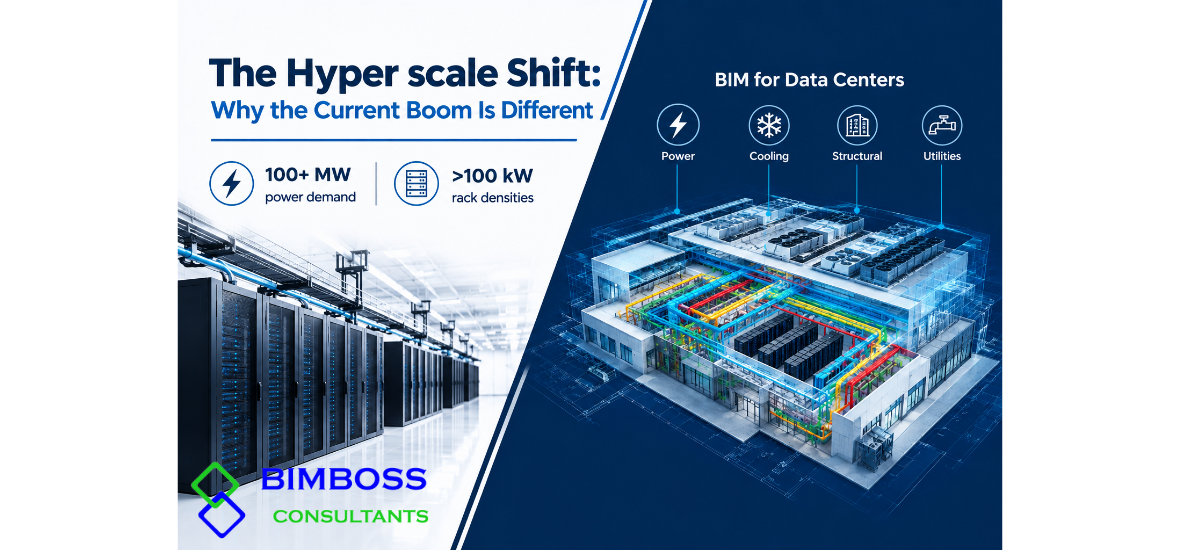

Generative AI is transforming data centers, driving demand for 100+ MW power and rack densities above 100 kW. GPU-intensive workloads require advanced power, cooling, and structural solutions.
For AEC teams, delivering these complex facilities faster without compromising quality is a growing challenge. BIM for data centers enables better coordination of power, cooling, structural systems, and utilities.
It also helps identify and resolve issues before construction begins, improving reliability and efficiency.
AI workloads are transforming data center design, with high-density GPU racks demanding stronger structures and concentrated load paths.
Liquid cooling systems such as direct-to-chip and immersion cooling are adding new piping, distribution, and space requirements. Power systems and building footprints are also evolving, from distributed power to modular edge data centers.
These changes increase architectural, structural, and MEP complexity. Stronger coordination and modular construction are becoming essential for faster, more efficient delivery.
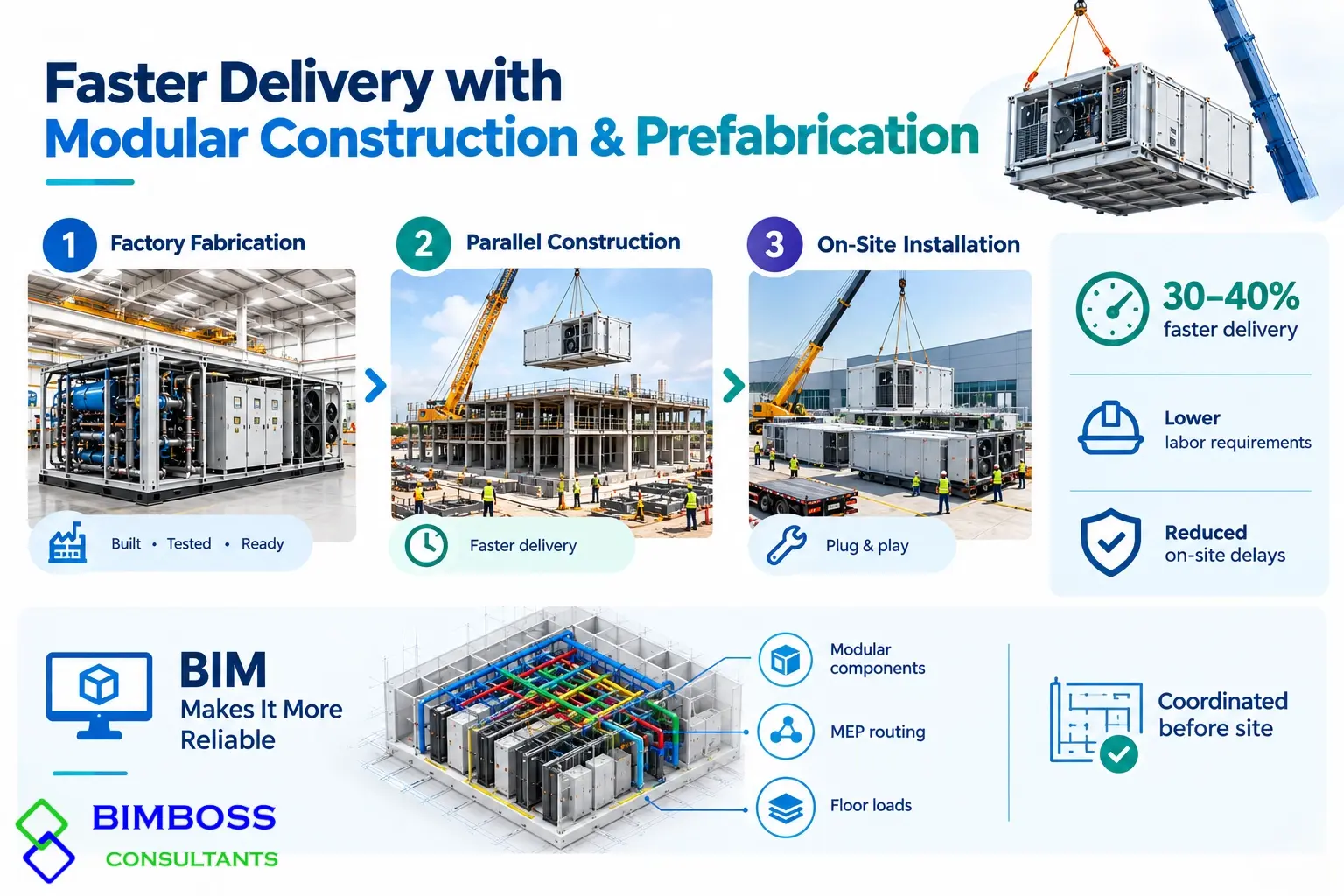 Modular construction and prefabrication are transforming data center delivery, helping compress timelines by 30–40% compared with traditional methods.
Prefabricated power skids and modular cooling units are factory-built, tested, and delivered ready for installation, allowing manufacturing to happen alongside civil and structural work while reducing on-site delays and labor requirements.
BIM makes this faster delivery model more reliable by digitally verifying modular components before they reach the site. Teams can coordinate structural penetrations, MEP routing, and floor loads while detecting clashes early.
Data centers are becoming a major factor in national energy planning, directly influencing AEC design decisions.
Rising power demand is driving greater focus on PUE, with AI-ready facilities targeting higher efficiency through better integration of cooling, electrical, and structural systems.
Micro grids, on-site power, and sustainable cooling are becoming essential as projects balance grid capacity, environmental concerns, and community impact.
Managing modern data center infrastructure without BIM and digital twin technology is no longer a viable option — the MEP complexity alone makes traditional documentation methods a direct path to costly rework.
Clash Detection: Prevents MEP, structural, and electrical conflicts in high-density environments, reducing costly construction delays.
Digital Twins: Connects the BIM model with real-time facility data to monitor power, cooling, airflow, and operational performance.
ISO 19650: Enables structured and auditable information delivery, strengthening AEC firms’ credibility for hyper scale and collocation projects.
Specialized BIM Consulting: Ensures asset data is properly structured for both construction and long-term facility management.
Executing a credible AI-ready data center design strategy requires more than technical ambition — it demands a disciplined framework that connects Modularity, cooling innovation, and workflow maturity.
Four priorities, handled in sequence, tend to separate competitive AEC practices from those still reacting to client demands.
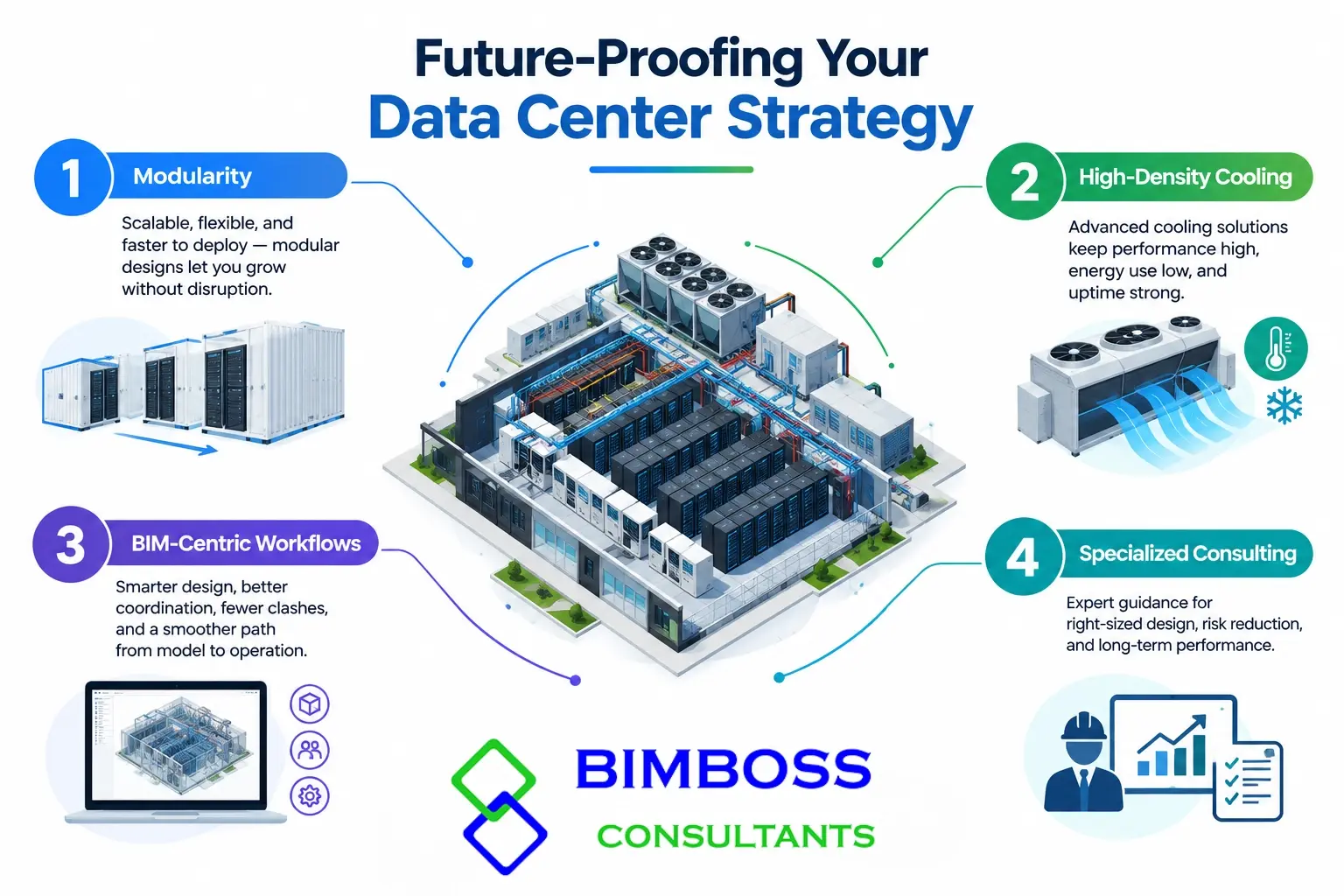 1. Modularity: Use standardized structural bays, Pre-Engineered power systems, and repeatable MEP layouts to support faster, phased expansion.
2. High-Density Cooling: Build expertise in liquid cooling and direct-to-chip systems to handle AI-driven rack densities and complex thermal requirements.
3. BIM-Centric Workflows: Use BIM for real-time coordination, clash detection, and sequencing to reduce rework and improve project delivery.
4. Specialized Consulting: Combine ISO 19650 expertise, digital twins, and multi-discipline BIM coordination to improve delivery and reduce project risks.
Expert BIM consulting helps AEC teams reduce construction risks through clash detection, coordinated models, and ISO 19650-compliant information management.
Combined with modular construction, digital coordination can validate MEP assemblies before installation, reducing rework and project delays.
Turn data center complexity into a competitive advantage. BIMBOSS CONSULTANTS brings the coordination, compliance, and digital intelligence needed to make every stage of delivery more predictable. While Pin-acle-Info-tech provides digital design and BIM solutions, BIMBOSS CONSULTANTS offers comprehensive DESIGN & BIM services tailored to project-specific requirements.
From Digital Twin to Physical Twin: The Next Evolution of Construction Technology
From Reality to Virtual: The Powerful Intersection of Drones and Digital Twins
The New Definition of Resilience in the AEC Sector
Building with Bots: The Role of Physical AI in Modern Construction Practices
